Why We Can’t Have Nice Things
(We’re too capable of adapting to shit)
Change is difficult. Often unwanted and generally resisted until no longer possible, only to be appreciated after it’s passed. (This month’s artist of the month, Scottie Miller, has a good song about that.)
The second half of that thought is that resistance is why we can’t have nice things. The failure to appreciate our own difficulty demanding change is all that stands in the way.
One of my favorite movie lines comes out of Matt Damon’s mouth in the Departed. He’s a hopelessly compromised liar in a relationship with his police psychologist, that the plea sort of explains: “If we're not gonna make it, it's gotta be you that gets out,” he explains. “I'm not capable. I'm fucking Irish, I'll deal with something being wrong for the rest of my life.”
There’s a lot of bullshit filling the media sluices with self-improvement garbage that involves people in rented clothes and cars cos-playing affluence to sell a vibe. Did we say vibe? We meant lie. Selling lies is a huge growth industry similar in many respects to helium. (To be fair, it’s down slightly because GLP-1 put lot of diet influencers out of business.) It’s just a different treadmill, preying upon a desire to change, but often not by encouraging the self-reinforcing habits and personal understanding & acceptance necessary for sustained change.
When the first method fails, there’s always another, and another and another...
Thinking Fast and… Done!
Sadly, we’ve allowed our cognitive biases and psychological predilections to be made a ready target for snake oil salesmen and more people are seeing the virtue of the grift than regulating it in any meaningful way. (Welcome to the Golden Age of Grift! Caveat Emptor.)
Our brains, in a variety of ways are what you might call lazy. One person’s laziness is another’s efficiency. Pyschologist Daniel Kahneman wrote a hugely influential book on this subject, Thinking Fast, Thinking Slow, which identified two systems of thinking – one based around abstractions and familiarity, leading to snap-quick judgments and decisions, the other (system 2 colloquially) a denser, more deliberative process involving self-reflection, values-taking, and evaluating extrinsic details.
While much of the books core was based on priming studies since discredited in the replication crisis, putting some of the book’s claims on shaky ground, the idea of a less-intensive, expectations-driven mental aspect is important. This is consistent with neurobiology findings that our perceptions are more shadows on the wall, enduring a level pre-processing based on our mind’s expectations.
We "see" what we expect to see, until we don’t, though the change may have occurred long before we noticed.
We’re also basically innately negatively polarized. Our brains seize upon dangers, and our negative perceptions or fears are amplified several times over good things. This kicks us into a more heightened state (fight/flight, hello cortisol!), but has sort of led to ever-vigilant attention/stress (see, paranoia) until the sound of the alarm becomes life’s background buzz.
Another much-quoted study wired brains of volunteers to conclude that it takes more mental resources to avoid sedentary behaviors than physical ones. This was offered in answer to the "exercise paradox" — why society grows lazier despite its greater awareness of the risks of an unhealthy, inactive lifestyle: We’re wired to value laziness; it’s the brain’s preferred setting. (Obviously there are many impediments to change.)
Paradigmatic Change
Suffice to say, staying with the current program is your brain’s preferred state, and it takes a lot to foment change, in part because overthrowing old habits, norms and ways of thought require so much energy and buy-in, whether personal or group, it takes time for the value of change to accumulate.
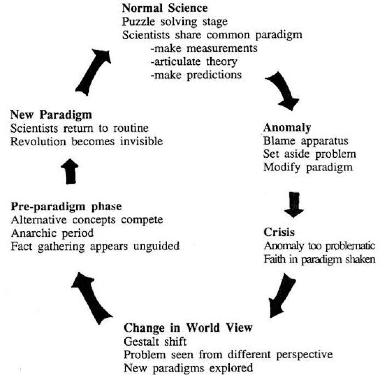
Thomas Kuhn had a lot of thoughts about this, but the one that sticks with me is the basic threshold idea that at some point maintaining or enduring Matt Damon’s fucked up system becomes more mentally and emotionally costly than attempting to change. Kuhn talks about how exceptions to the rules are generated and ignored until that reality is no longer tenable, and it requires a paradigm shift.
There’s the secondary issue that real change, while it begins with one person, must proliferate. But how does that signal repeat and grow from weak to strong? Especially when the content of that signal is one which implicates the listener and attempts to enlist them in the energy-intensive task of extrinsic change which is much more complicated if perhaps a bit less personally demanding.
The fact that is demanding is one factor. It requires accommodations the party may not want to make (see, misogyny), changes of status or expectations of behavior. Change is almost always on some level an expression of power, which those who are lose their privilege will resent. (Call a wah-mbulance.) It requires a large expenditure on our “executive function” which anyone with ADHD can appreciate doesn’t come cheap/easy.

Beyond that, there’s a bystander effect which can also works sort of in reverse. For those unfamiliar, the bystander effect was coined in relation to the murder of a woman, Kitty Genovese, in the clear sight of numerous onlookers. Initial research suggested the more people, the less likely someone will step up. While those studies have been countered, and there is tremendous debate about the size of the effect, there are a number of factors that have been isolated as key variables in people’s behavior.
Theses include the ambiguity of what is going on, an evaluation of the relative threat/cost, the number of others/degree of responsibility, and the group cohesion, leading to greater altruism. (Stanley Milgram, of the famous electric shock test, has suggested the bystander effect is related to strategies people use to deal with information overload. This feels relevant with regards to a world whose threats are far more “present” due to social media collapsing the globe onto a screen.)
The most interesting of these is ideas of responsibility or the diffusion of responsibility, i.e. “why can’t someone else do it?” Harvard professor Catherine Sanderson studied under Phil Zimbardo (of the Stanford Prison Experiment, where the student “guards” began to abuse their student “prisoners”). She looks at brain imagery (EEG) to explore what’s going on in our minds during these situations in her book, Why We Act.
She finds in cases like the Stanford Prison Experiment or the Milgram Experiments that having an authority to take responsibility for their behavior (the Nuremberg Defense), allowed people to act badly with less compunction.
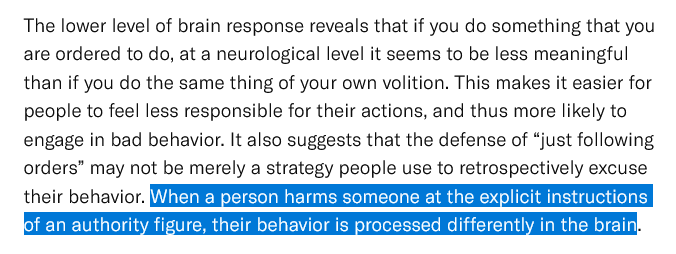
What Sanderson arrives at is something Police Reform activists have been agitating about for years. It’s not about the bad apples. It’s about the Thin Blue Line. It’s not the behavior that kills an institution, it’s the silent complicity that fails to acknowledge the harm.
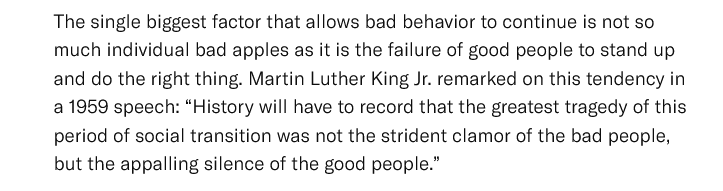
It is only at those moments when people understand the consequences are coming for us all (Pastor Martin Niemöller's famous anagnorisis) that we rally to action. It’s a matter of understanding what’s going on, realizing the stakes and then understanding how to take action.
That’s a lot of cogitating and noticing things for people that are consumed with their own lives. Particularly if you are the people they’re coming for. Posh people have the luxury of considering the consequences of state actions. Them and the unemploy(ed/able) or otherwise recalcitrant (*waving at the camera*).
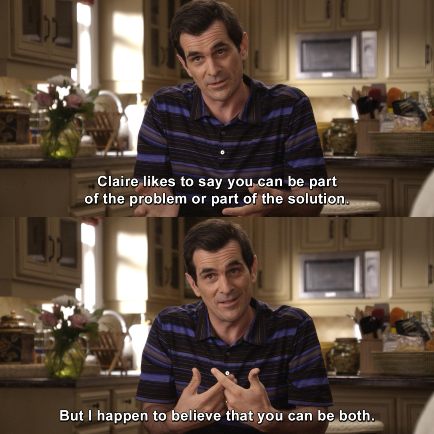
This is why social change tends to only happen when people are agitated into urgency and recognize the salience. Or put simply, you need an on-the-bus/off-the-bus moment when people realize they can be a part of the solution or by default, they’re part of the problem. Occupy Wall Street was the initial signal we were heading toward this moment. No Kings is its spiritual progeny.
Everything Is Fine
The reason this is difficult goes back to something we were talking about earlier, about how being under constant stress short-circuits your fight/flight system. This isn’t a metaphor, you are literally pumping yourself full of stress chemicals meant to deal with urgent, high-intensity situations every day of your life.
It’s our belief that this is one of the big engines of modern nostalgia for a simpler time. While life was never simpler for women and minorities who had significantly less rights just 50-60 years ago, there was a moment not too long ago where we weren’t so aware of all our awful (collective) behavior (24 hour news cycle can be the 24-hour guilt cycle).
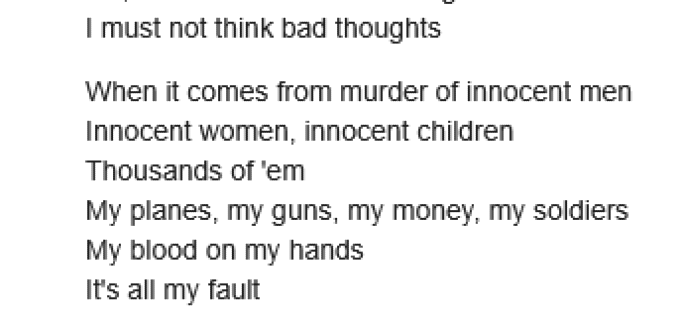
On some level trying to diffuse your own responsibility is no more than a survival mechanism in an interconnected world where you can never escape some quanta of responsibility for the sorry state of the world. Indeed, this was the underlying premise of The Good Place: Life has become too complicated and ridden of unintended consequences (compromises) for anyone to actually accomplish enough good to ever get into the Good Place.
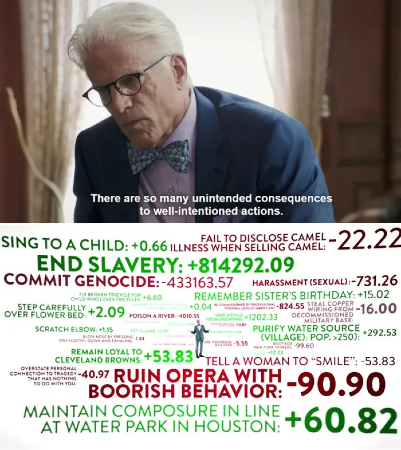
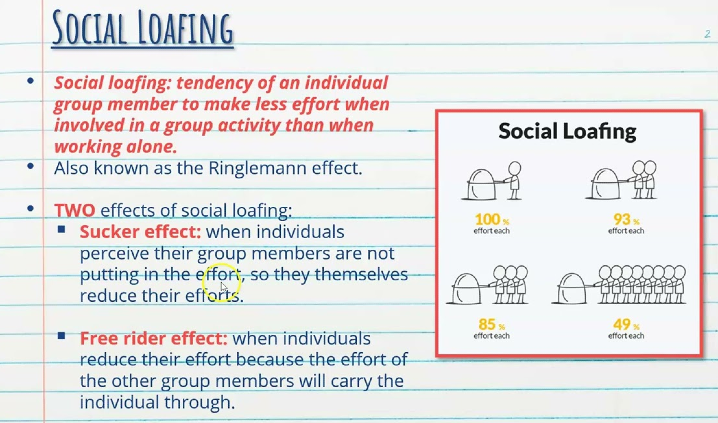
Which brings me to the biggest reason why we can’t have good things, alluded to in the subhead and the above idea: We get used to something bad before we can rally enough people to change it. We adapt, work around it and hope someone else changes it. This is known as "Social Loafing" a much-studied psychological effect alongside the bystander effect.
That’s why so many of us complained so bitterly about the behavior of the media normalizing and sane-washing Trump’s authoritarianism when his rolling coup should have been throwing up more red flags than a communist color guard.
Some of it is just the corruption of democratic elites which has been pretty in-your-face since the DLC took over the Democratic National Committee. They'd make Casablanca's Renault look like Herman Goering.

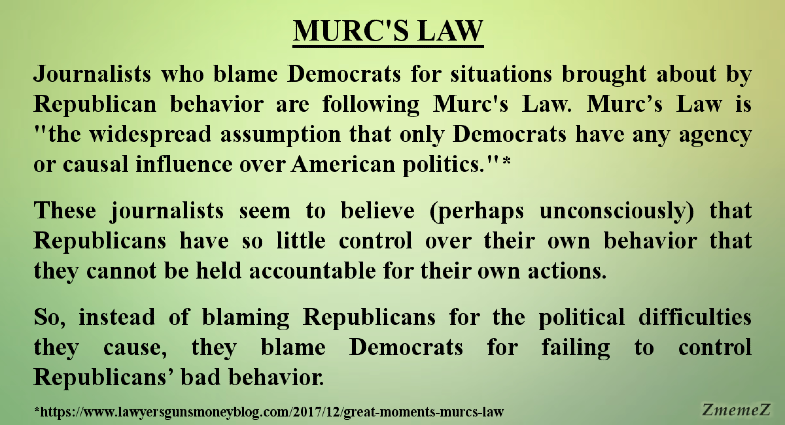
The GOP found that with a message bubble they can lie all the time, deeply changing long-running political calculus. The press internalized that that Right will only gaslight them, and generally stopped asking the same questions of the left they ask of the right. It's known as Murc's Law.
This is a form of adaptation, our greatest human strength and weakness. It’s reminiscent of an apothegm we coined about living in California:
California is the best place in the world, because you can do whatever you like and nobody minds.
California is the worst place in the world because whatever you do, no one gives a shit.
We have long toyed with the idea of including the paranthetic “(unless it advantages them)”; but that’s beside the point. The idea is that our ability as humans to endure any kind of bullshit, ala Damon in The Departed, is a terrible thing when it attaches itself to group-inflected or authoritarian-ordered bad behavior. One need only look around.
It’s the basis of the boiling frog metaphor, which is actually a lie, wouldn’t you know? They’re low-key misinforming you in way that implies self-destructive indolence is perfectly natural. They’re dead-set on convincing you Learned Helplessness is your natural state!
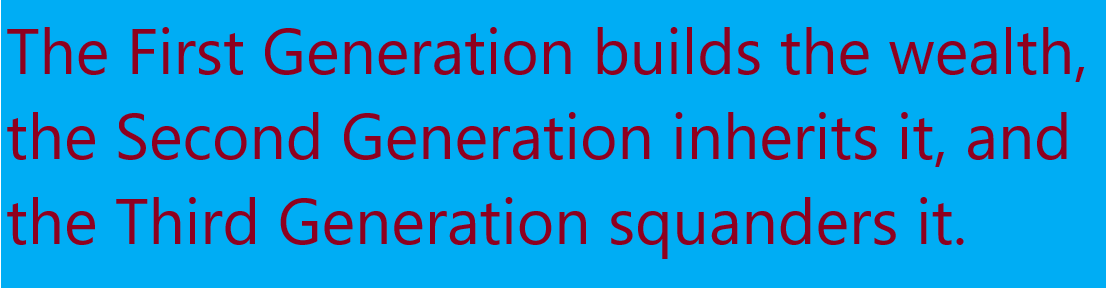
It is another way in which our natural predilections are being played by those who want reverence and obedience, not because of their great character or vision, but because for the moment they have money and have used it to buy power, arguably the two most fleeting things in existence, though they’re certainly trying to rig the game. Can they stop a third generation from existing? (Studies show 90% of family wealth is gone by the third generation.)
For us the crucial aspect is that the upper middle class, particularly Baby Boomers and some Gen X, are so accustomed to this and insulated from the chaos (still in earlier stages of When They Came For…), have lost access to their fight/flight response and have ticked over into a self-preserving denial which is becoming their compromise. (Punch Left at the people who aren’t down with Soylent Green. “They already explained it’s not people, it’s the undesirables!”)
As Shermni Kruse, J.D. (The Stoic Heart, the Human Whole) argues there is a kernel of truth to the boiling frogs analogy with regards to people. Our brains are wired to act in self-preservation and efficiency in most cases.
We Gotta Get Out of This Place
However there is also a human altruism and sense of group connection that binds us when things grow tough, and that adaptability becomes a strength again. We are born to cooperate with other humans. Isolation is a modern luxury, not the common ancestry, and that commonality is a path to greater happiness than Adam Smith’s everyone-for-themselves. It shouldn’t be a novel insight that selfishness is a good virtue for those already sitting atop the pyramid to stress to those below them.
This is because, ironically, the same process of dis-individuation that allows good people to participate in horrific crimes particularly rape, is the same mechanism that encourages people to make sacrifices for something larger than themselves. Seeing them as part of a group enables the self-sacrifice necessary for mass movements to succeed.
There is even reason to believe that altruism is the more natural response when the costs are low, judging from the deliberative time of these decisions.
It’s a reminder that we are really the ones who decide if we have nice things, but it’s predicated on sublimating selfish desires in favor of ones benefiting your group/social caste/family. This is why divisive agitprop is such a necessary component of authoritarianism and capitalist onanism is an enemy of democracy.

We can have nice things, but demanding them isn’t enough; we have to collectively unite and seize them because the power to distribute (or stall) these “goods” is where power is derived. Helping people remember this, which we on some level all intuitively know, is apparently the driving characteristic in our late-stage capitalist conundrum of increasing, debilitating corruption and inequality.
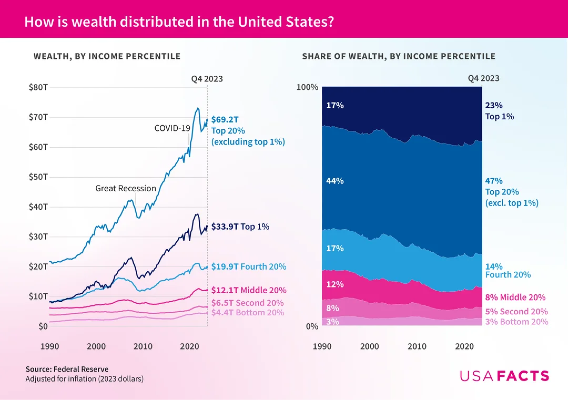
It’s on us because nobody else is gonna do anything, and change will require a critical mass pulling together.