Artificial Life, Strange Metals, Long COVID & Researcher Pay
- The First Synthetic Cell
- Are Born-Blind Immune from Schizophrenia?
- Are Strange Metals Result of Entanglement?
- Is Long COVID Attacking Dopamine Regulation?
- Low Grad/Postdoc Researcher $$$ Academic Challenge
U of MN Biologists Create World's First Synthetic Cell
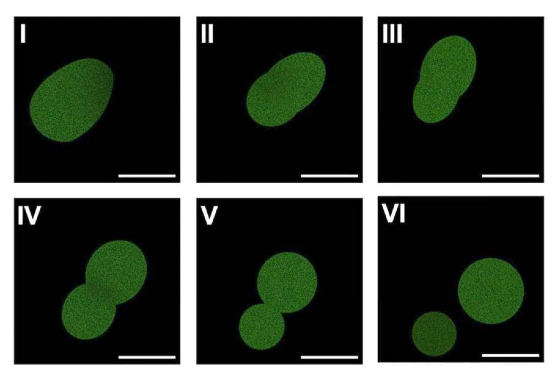
Knot Graf: Parts is Parts, went the old chicken nugget commercial, and University of MN researchers have done their part in proving this, creating the world’s first synthetic cell. What are we but a complex series of highly-interdependent chemical process? Synthetic biologists Kate Adamala and Aaron Engelhart spawned “Spudcell” (after the first space craft, Sputnik, and the cell’s potato shape) by combining the chemical building blocks piece-by-piece.
“I know the full ingredient list of the cell, I know exactly what chemicals, what molecules at what concentrations,” Adamala told CNN. “It is fully defined, which means we can engineer it.”
Is it Alive?: No, but it does feed, grow and divide. It’s not self-sufficient – they have to give it food and ribosomes, and it can’t clean out its waste or protect itself. It’s only about 150-200 molecules compared to a biological cell that can hold millions if not billions of molecules, and generally peters out after five generations.
Adamala calls it “an incredibly wimpy organism that right now basically does nothing other than to eat and occasionally make a daughter cell.”
The replication is different as well. A natural cell uses a cytoskeleton, a structural framework that SpudCell lacks. The synthetic cell, by contrast, produces proteins, which crowd at the membrane, forcing it to split.
“We’d like to be able to have it undergo growth a little bit better, have the process be a little bit more controlled and synthesize their own ribosomes,” said Englehart, U of MN Associate professor in the Department of Genetics, Cell Biology and Development. “There’s definitely areas in which we’re excited to see where the field and our labs take it over the next coming years.”
“It’s just the beginning,” Adamala said. “It’s a chassis that we’re hoping to build on.”
Context: Given our limited understanding of life, it’s a tremendous breakthrough built on a long series of advances, but it’s only a prototype, far from practical applications, such as in cancer testing or drug creation. The hope is the process can be a sort of open-source cookbook that others can expand upon.
“Building a cell from scratch means you are no longer tied to the constraints and evolutionary baggage of natural biology,” Yuval Elani, an associate professor in biochemical technologies at Imperial College London, told CNN. “It opens up the possibility of designing systems and programming them to do things that living cells may not do easily, or may not do at all.”
Why Is It Those Blind Since Birth Don't Get Schizophrenia?
Knot Graf: In the 1950s researchers Hector Chevigny and Sydell Braverman began examining the blind to prove their mental and physical ailments were no different than the sighted. Though the early data was sparse, in the eighty years since national databases of mental illness have been maintained there have been no reported cases of schizophrenia among those blind from birth (or who became blind shortly thereafter). Philip Corlett, a Yale neuroscientist, believes it’s related to how we believe our mind processes information based on predictions.
Our brains operate on an anticipation basis (presumably for safety reasons) where it guesses what’s likely to happen before it does based on inference, causality and past experience. We don’t actually experience stimuli first-hand. On some level this “future” prediction is a hallucination that is corrected by moment-to-moment sensory data. Corlett wondered if schizophrenia manifests as an unreliable prediction process and if that could be related to its lack in those born blind.
Definitions: According the Mayo Clinic, Schizophrenia is "a serious mental health condition that affects how people think, feel and behave. It may result in a mix of hallucinations, delusions, and disorganized thinking and behavior. Hallucinations involve seeing things or hearing voices that aren't observed by others. Delusions involve firm beliefs about things that are not true. People with schizophrenia can seem to lose touch with reality, which can make daily living very hard... many people with schizophrenia don't know they have a mental health condition and may not believe they need treatment.

Can You Hear Me Now: Corlett used comingled sensory events to engender a tone where there wasn’t one in classical conditioning experiment. HE found those already “prone” to hearing voices were more likely to hallucinate the tone. He hypothesizes that absent sight by which to organize the predictions regime, the brain reorganizes in a manner that devalues or better contextualizes how it processes stimuli.
“If you don't have the visual system, which is a dominant way of making predictions, then maybe you don't have this over-expectation of auditory stimuli, or maybe your expectations about auditory stimuli are different,” Corlett told Discover. “And that might protect you against this subsequent development of psychotic symptoms.”
Spooky Solids: Are Strange Metals that way from Quantum Engtanglement?
Knot Graf: In recent years a new class of “strange metals” has emerged whose electrical conductivity and resistance don’t conform to modern theories in which electrons move like a crowd exiting in an orderly way down a concourse. Experimentalists at TU Wien at Vienna University of Technology suggest this behavior is driven by entangled electrons, demonstrating not only that entanglement can be quantified but that it explains this behavior.
Context: In school you learned about how matter is a particle and a wave, and that this is a continuum, such that even things of significant mass have a modicum of wave qualities. This is known as the particle-wave duality.
This is a key aspect of quantum mechanics which most of us learned about through the Schrodinger’s Cat thought experiment. One of the other key facets of quantum mechanics is a process that Einstein called “spooky action at a distance” where a pair of electrons can become entangled and change states in unison instantaneously across distance, as much as 33km so far.
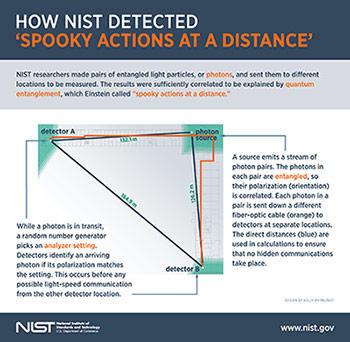
What initially seemed a fantastic hypotheses has become an almost mundane part of life; it was always around, we just didn’t notice because the quantum effect is so small. But it’s still measurable. The research at Tu Wein validates a theory that the strange electrical behavior in these metals is driven by entangled electrons whose co-dependent nature seems to catalyze low-resistance electrical flow.
How’d It Work?: Innsbruck quantum physicist Peter Zoller and his team showed that the concept of quantum Fisher information can be used to detect quantum entanglement even in large many-body systems. The idea is that if you disturb a normal system, the effect is typically small, as joggled particles will individually resituate. But if they’re entangled that effect is gonna be larger, because not just one particle changes when electrons are tangled. They demonstrated this by firing neutrons into a strange metal composed of cerium, palladium and silicon.
"In a normal material, one would expect a neutron to transfer its energy to an individual particle," says Mazza. "But by analyzing the data using the quantum Fisher information, we found a response that cannot be explained in terms of independent particles. Instead, it indicates that groups of at least nine quantum-entangled entities act collectively."
"What we see here is not a detail of one particular material, but a general physical principle," says Fakher Assaad from the University of Würzburg, lead theorist of the work. "Strong entanglement appears to be directly linked to the unusual behavior of strange metals."
Is Long COVID Blitzing the Dopamine System?
Knot Graf: Researchers led by Dr. Jeffery Meyer at the the Centre for Addiction and Mental Health in Toronto, building upon their prior research, have found the most direct evidence to date that long COVID affects the brain's dopamine system, a key neurotransmitter linked to reward, pleasure and motivation. This complements earlier studies that found COVID impacted serotonin levels, another key neurotransmitter connected to feelings of comfort, satisfaction and satiation.
The Context: It’s been a crooked road for Long COVID sufferers to acknowledgement and greater understanding of the syndrome, which is an umbrella for a number of potentially distinct deficiencies that go well beyond brain fog and chronic fatigue. There are hormonal changes in cortisol and testosterone, and while some may primarily experience a neurocognitive issue, others might experience cardiovascular or gastrointestinal issues. Some might otherwise present as signs of aging making them hard to disentangle.
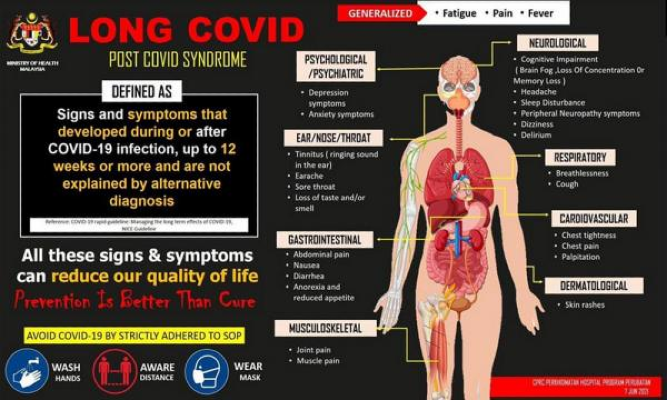
These diverse symptoms have challenged doctors, further amplified by the fact that a third of the population isn’t even aware of Long COVID and may not be aware they’re suffering. There are many theories from a persistent hidden viral reservoir, like HIV, to autoimmune reactions triggered by infection to byproducts of tissue damage and aftermath of the attack on the immune system. It’s estimated that 8% of the population has suffered from Long COVID symptoms.
A 2023 Penn study suggested gut inflammation from the virus may interfere with the gut's ability to produce serotonin. Researchers found that when tryptophan absorption is reduced by persistent viral inflammation, serotonin is depleted, leading to disrupted vagus nerve signaling, which in turn can cause several of the symptoms associated with long COVID, such as memory loss.
Brain Scans: Researchers employed positron emission tomography (PET) brain imaging to examine the nerve density at different regions in the brain related to motivation, movement and thinking. Building on a prior study that found inflammation, this study found comparing the scans of long COVID sufferers to healthy adults their dopamine nerve receptors were 16-20 percent less dense. Parkinson's disease and methamphetamine addictions produce similar decays in dopamine transport nerve endings.
“These results indicate that long COVID is, at least in part, a disorder of the brain’s dopamine system,” adds Dr. Meyer. “This suggests that repurposing medications that augment the function of dopamine-releasing neurons, including dopamine precursors and inhibitors of dopamine metabolism, could be a promising approach.”
Weak Researcher Compensation Latest Academic Science Challenge
Knot Graf: Following up on ongoing concerns about compensation levels for federally funded research, the Government Accountability Office (GAO) recently released a report studying the direct funding of graduate and post-doctorate researchers at 40+ research universities. (Direct funding is defined as fellowships, trainees’ grants, and scholarships as opposed to those funded "indirectly" via university grants or contracts.)
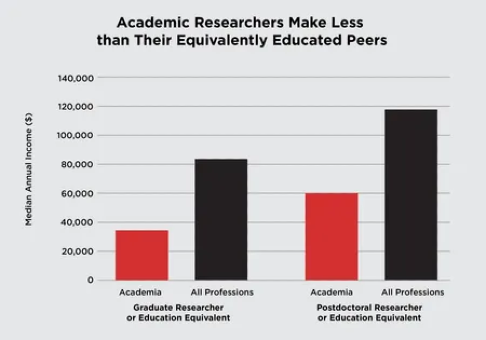
It found graduate and post-graduate researchers were paid a median amount of $32,000 and $62,000 respectively, compared to the $82,000 median salary of among on those with at least a bachelor's degree, and $118,000 among the general populace with a graduate degree or its equivalent. Suffice to say, that's a steep trade-off.
Context: Federal agencies fund 26 – 28 percent of graduate research and half postdoctoral researchers, primarily through the National Institutes of Health (NIH) and the National Science Foundation (NSF). Meanwhile science and university federal grant funding have been under siege during the latest Trump Administration, which has cost federal science agencies a fifth of their staff and has imperiled 40% of the NIH budget, not to mention numerous extent grants summarily pulled on flimsy or non-existent pretext.
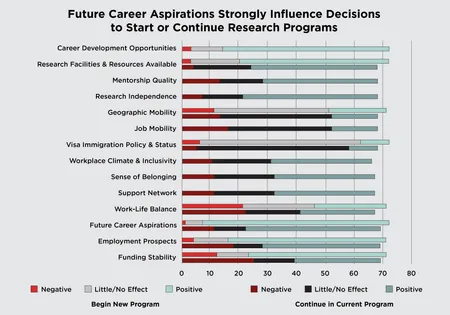
Trade-offs: Brian Dias, a neuroscientist and geneticist at the University of Southern California is also director of the office of postdoctoral affairs at the Children’s Hospital of Los Angeles, affording him an opportunity to speak to a lot of medical researchers. While career and lifestyle expectations certainly play a role, most who continue in academica, Dias said, were familiar with the financial trade-offs, with their choices more indicative of people’s research interests than compensation levels. The GAO noted career aspirations, facility resources, and funding stability ranked as stronger influences on whether to start or continue a research program.
"I think postdocs understand entering academia that those postdoc positions often pay below those of peers in for-profit industries,” Thomas Kimbis, the executive director and chief executive officer of the National Postdoctoral Association, told The Scientist in an email. "But pay levels [that are] only half of what PhD's earn in non-postdoc positions is unsustainable and requires rethinking of our national research investment priorities and better public-private solutions."
Think Smaller: The temporary solution is to take the money out of the research end for the time. Some are concerned how this would impact an already competitive grant situation if it meant less grants, ergo less positions.
“I would be okay with having a smaller lab," Dias said, "if I were paying these individuals, who have so much experience [and] bring so much value to my lab."