What Do We Get Out of This?
The Cumulative Wisdom of Erik Erickson’s Developmental Psychology
We have all these collective experiences, but sometimes it takes a theory to weave them together and give a form to this thing that on some level we all know. That’s one of the reasons I took psychology in college; I wanted some language to understand what I was experiencing. Life is bounded by our ability to understand it. Having uncoded structures or paradigms, which is to say tested theories on how things work, is crucial to negotiating it.
Many people today suffer from a brand of narcissism dubbed “NPC Syndrome” where they treat everyone they interact with as though behind a glass and as some kind of instrumental mechanism to get something they want. You don’t have to have dated a young man to appreciate this brand of entitled-theory-of-mind, where others exist only to satisfy their needs.
But we could talk all day about the pathologies of modern life, and in some sense, that’s the purpose of this site. However, I specifically want to talk about this particular psychological paradigm which sits on the top shelf, alongside Piaget’s theories on childhood mental development, Roger’s interrogative technique, Bandura’s social modeling and conceptual mate Leon Festinger’s cognitive dissonance and social comparison theories.
Like a lot of major psychological tracts, his work is somewhat abstract and conceptual, and doesn’t lend itself to research. It doesn’t attempt to predict so much as provide a framework for discussing and understanding the stages of psychological conflict as they occur throughout one’s life.
While Erikson situated the conflicts at their sort of high water mark in life, he also believed these conflicts are always present to some degree, and those that remain unresolved will inhibit the ability to progress in the subsequent stages.
Erikson’s Eight Stages of Human Development
Though Erikson proposed eight stages, when his wife reached 93, she wrote about a ninth stage that, if you live long enough, speed runs through the prior eight again as the conflicts of life reassert themselves as age advances, mental acuity slips and our ability to act independently diminishes. Yes, we go out much like we came in, if you live a long life.
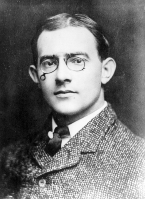
Erikson himself is an interesting case who, as a bastard with fair hair, blue eyes and a Jewish upbringing, struggled with ego identity for much of his young life in Denmark. He showed a natural affinity for children and after tramping around Europe in his 20s selling his sketches where he could, taught art, and was eventually was employed to do the same for the children of the rich clients of Anna Freud. She noted his skill with children and encouraged him to study with her staff at her Vienna Psychoanalytic Institute.
Erikson himself is an interesting case who, as a bastard with fair hair, blue eyes and a Jewish upbringing, struggled with ego identity for much of his young life in Denmark. He showed a natural affinity for children and after tramping around Europe in his 20s selling his sketches where he could, taught art, and was eventually was employed to do the same for the children of the rich clients of Anna Freud. She noted his skill with children and encouraged him to study with her staff at her Vienna Psychoanalytic Institute.
Erikson came to America and was three years into his doctorate at Harvard when he had such a grievous problem with what was being taught that he struck out on his own, teaching at Yale and later going into private practice on the West Coast and teaching and UC-Berkeley. He left rather than sign a loyalty oath, though he did eventually wound up back at Harvard.
Studying under the Freudians, Erikson accepted most of the structure of childhood without the psychosexual baggage. His first four stages correspond to Freud’s first four stages – oral, anal, phallic and latency. Erikson lacked the same level of sexual fixation and posed his stages as steps on a staircase to ego integrity, a kind of mental balance where one understands their own weaknesses and challenges and incorporates them into their identity.
Erikson’s emphasized that synthesizing these dualities was not about dominating the negative trait, but finding an adaptive ratio. Balance is about retaining both impulses. Some mistrust protects against gullibility, shame inhibits shamelessness, and guilt limits ruthlessness. What’s functional will vary by the individual and where they are in their life. There is no one size fits all.
Change and Growth All Life Long
Freud, of course, felt our personalities are set by the time we reach adolescence, while Erikson believed we grow and change and learn our entire life. That was a daring idea. Not only did that revolutionize the science, but the idea of productive, adaptive growth that builds inner strengths was a “healthy” new perspective for a science that had mostly been focused on pathologies and mental illness.
Erikson believed successfully facing these challenges rewarded us with particular flavors of mental/ego resilience.
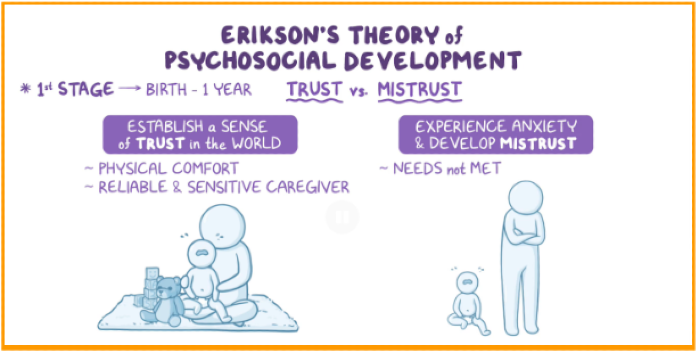
For example, the first stage of Trust versus Mistrust seeds our orientation to strangers. As a baby we must rely on others for everything. The dependability and availability, physically and emotionally, of our caretakers shapes one’s belief others can be trusted or relied upon. Erikson felt that when you successfully foreclose this stage you develop a sense of Hope, which synthesizes the two: Openness to experience, tempered by commensurate wariness that danger may be present.
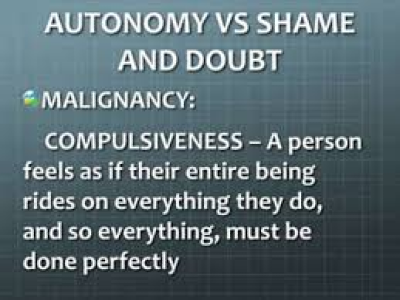
The second stage is Autonomy vs Shame and is the budding roots of personal independence. Caregivers can nurture the idea that the child can do things for themselves or diminish them for their failures, discouraging them with abiding self-doubt. Mastering this stage builds confidence and encourages the child to seek their Will, instead of looking to others for permission or validation. This is where toilet training and the “terrible twos” challenge young parents ability to be loving and supportive.
The third stage is from the ages of 3 to 5 children begin asserting control over their environment resolving Initiative vs. Guilt. To be fair, this is a similar conflict of the second stage, autonomy/shame as both influence a child’s sense of agency. It’s also a crucial time for developing a child’s sense of fancy as they learn to negotiate what they can imagine and what’s real.
Similarly, the virtue that is achieved, Purpose, is preciously close to Will. Presumably, in this context the idea of will without purpose suggests a kind of directionless restlessness, and perhaps this is a case where a trait is essentially being honed.
That fits in with the fourth stage, from ages 6 to 12, which Erickson termed Industry vs. Inferiority. Again the context is agency, though it this case it concern competence and social modeling. The prior two stages on some level are about intrinsic motivations to operate in and change a child’s environment. Here the social milieu is also relevant as the actions are now measured against peer group competencies and social modeling starts to kick in.
If the child learns industry they will see themselves as capable and won’t shy from experiences out of fear of failure. The virtue here is Confidence, arguably the single-most important interpersonal skill to master (or fake). In this context, confidence is the laser light of purpose: it intensifies whatever drive already exists.
Adolescence covers middle and high school and not surprisingly is the culmination of Identity vs Role Confusion. Of all the negative traits, it’s almost easier to see where a little Role Confusion would catalyze a sense of sympathy and a bit more flexible personal perspective. However under the hot Klieg lights of teendom, nothing makes you sweat more than not knowing your lane.
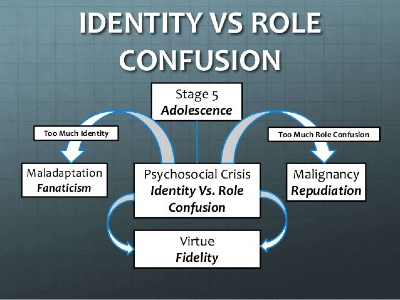
There’s a lot of outfit changes but the idea is settling on one identity (or two or three) alleviates the pervasive existential self-doubt. The virtue is
Fidelity, because a sense of self is so psychically important, and coherence provides a better shape to one’s actions. Until you define what you believe and care about, one’s own actions are in constant flux as the shape of one’s roles chafe under a changing body/psyche. Achieving a sense of who we are, so important to Erikson, was one of his major focuses in his literature and his own life.
The sixth stage, Young Adulthood, is about the ability to make yourself vulnerable and form lasting bonds. This is most of your life, this Intimacy vs Isolation, and it sure AF doesn’t end with marriage (at least for many of us), I’m sorry to say. In my own case, I’ve gone back and forth. Forging an intimate open relationship is beautiful when it’s accomplished but getting to the point often feels like an Underwear Gnomes plan.
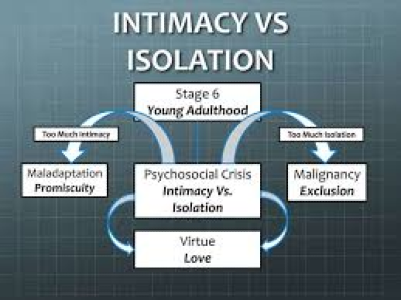
The idea that the stages build on each other makes the most sense here. There’s no doubt prior stages define the character of the person and that “wholeness” is a measure of healthiness. Studies have shown those with a stronger sense of self are more capable of sustaining relationships. The virtue of this phase is Love, which can definitely be a trait you only possess provisionally, and in the right situations. Some people aren’t worthy of our love or only take. Negotiating difficult relations, and learning your own boundaries is the other, unsaid virtue, and feels very much a continuation of identity/role confusion, because intimate relations demand clear roles in many cases.
Somewhere Over the Rainbow: Middle Age and Beyond
The seventh stage, Middle Adulthood, begins are 40 but looking around I’m pretty sure that’s been moved back a few years. (I’m only half joking.) This is dubbed Generativity vs Stagnation but I think Pragmatism vs. Nihilism might work better, just from experience. While the people in your life can create meaning autonomously, that doesn’t generally happen without investment or, say, people. The lives we lead anymore don’t lend themselves to personal connection and so stagnation is close to the status quo.
One is left with a choice of giving up or trying to find some way to create meaning. It’s a fucking challenge to do on your own. But one can’t always stay married; it’s not always our decision, and dating is… well, I’m coming around to the idea of just having a lot of friends. I will start with one. I mean, I assume. At some point.
The idea of finding something to do worth worth your time is a huge issue after a certain age, with “worth doing” a huge and very ly defined personal lift. When the kids leave the house, “worth doing” gets a real workout since those muscles often go slack after years of sublimating that anxiety by raising your kids. What do you do now? If it goes well, you develop the sense of Caring.
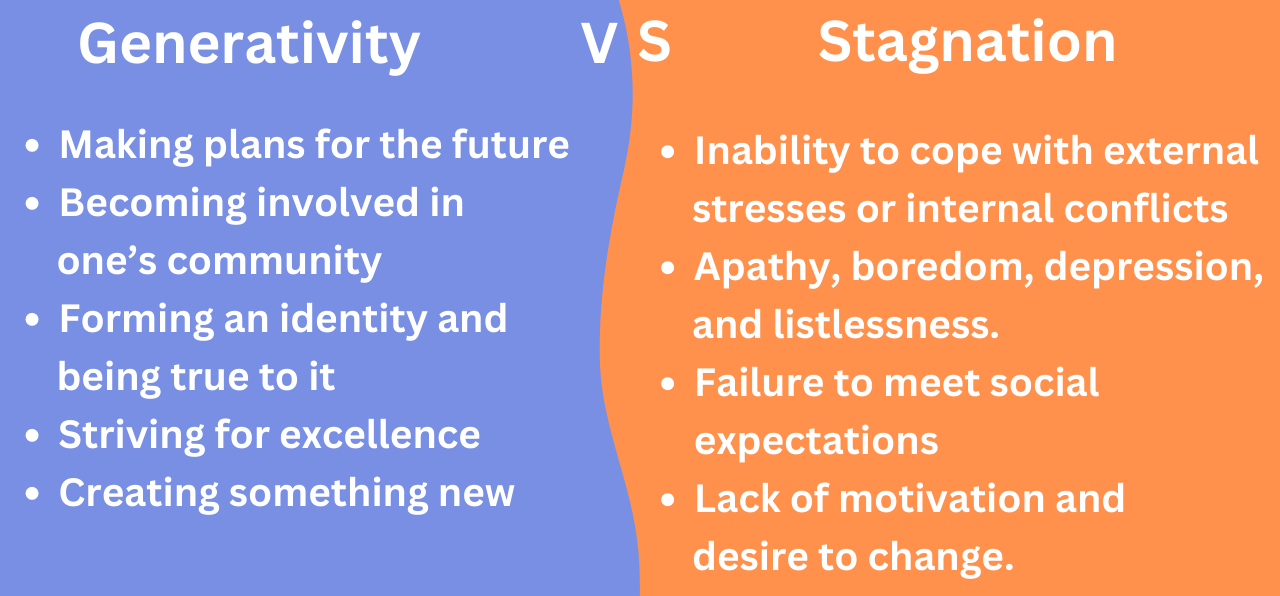
Just say that a few times to let yourself soak in the irony – at least from my vantage point, that the older you get you find fewer and fewer things to care about. Emptying those closets is such a relief it’s not always easy to stop, and the people you meet each day people aren’t necessarily going to change your mind. Besides they all have their own reckonings to plan for.
’ll be honest: I’ve never been so torn on Kurtz’s mad final epiphany. Some brutes deserve to die, that’s just unconscious knowledge. But it’s difficult even finding people worth having a conversation with sometimes.
The final stage, Ego Integrity vs Despair, begins around retirement which offers a clear reason why Boomers never retired. Most would beg for an opportunity to greet people at Walmart before spending that much time on self-reflection and making peace with a past that’s measuring your box as we speak. As Billy Joe Shaver once immortally wondered, How do you remain an outlaw, when you’re no longer wanted? Bury your head in work is a solution in the same sense as alcohol. (“Sweet liquor eases the pain!”)


The by-product of all this adaptive consideration is Wisdom which sure AF feels wasted on people over 70. It’s about as anti-climatic a trait as possible! Talk about a Cracker-Jack prize. What’s worse is that there’s precious few if anyone interested in being regaled with your wisdom at this point! What a gype! It’s an object lesson in obsolescence.
Indeed, my picture of old age is a bunch of old guys spitting out the names of random athletes with short careers to each other and chuckling. “Yup, I was there, isn’t that something.” Well, I guess it beats a lit cigar in your ear amirite!?!!
Maybe I’ll make a bucket list or something? The issue is that if you’ve gotten to the last stage and you aren’t wise yet, there ain’t much time for it to happen. And a ninth stage where you speed run the prior eight in reverse order as your faculties deteriorate? Doesn’t that sound like fun!
The secret – Not The Secret, which only manifested a divorce in my case – is to enjoy the process, because if you get to the end of the ride expecting a prize or validation or even a participation trophy, you’re liable to be deeply disappointed. Enjoy the moment, and do your best to plan for the next without diminishing this one. No easy feat, admittedly, but trying is all there is.