Employment Reaches Fork: Enshittified or Bespoke?
Job Boards are the Walking Dead. Can we survive?
We come to bury Job Boards, not to praise them. Once hailed as a brilliant invention, they grew beyond their ability to provide value and just kept going like every large institution in American life, trading ubiquity and control for value and purpose, skipping along the gilded path to management enrichment and cultural impoverishment.
It’s reached the point where we've created a tapable sign solely for such occasions:
Tech: The cause and solution to all our problems.
If the drug companies taught us anything, it’s not to solve a problem you can turn into a continuing profit center. Psychologists probably wish they’d patented it, before psychiatrists took their jobs.
As a journalist, we were at the bleeding edge of digital technology. We filed stories via dial-up, pioneered online magazines, then watched them all disappear, replaced by 100 times as many individual blogs as social media destroyed the alternative media and any gatekeepers / cultural curators by destroying the platforms. Music journalist were front row to musicians enduring the same fate.
We could argue if social media is an effective replacement, and if one set of gatekeepers was actually replaced with another, but the larger idea is that while digital tech has democratized the creation of content with one hand, it has also decimated the economic system (gesturing toward a meritocracy without...) that supported creation. It may have reduced the space between the stage and the crowd, but all it seemed to really enable is better panhandling.
The same thing has happened to Job Boards. (See also, Online Dating, on this site.)
Waiting For Godot
Where once the job board was a locus on which to center your job search, it’s quickly turned into a malevolent Rube Goldberg machine that swallows your resume, mines it for keywords and spits out a stack of 250 applicants.
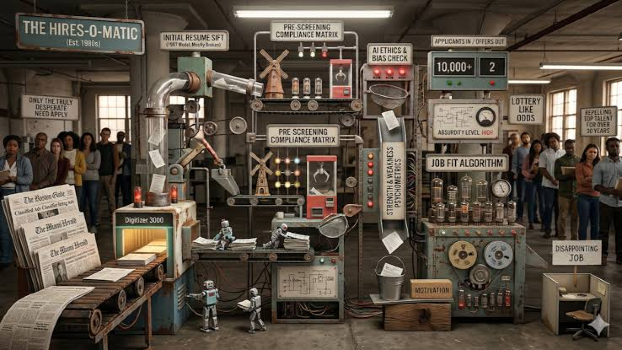
It’s become shopping for music by examining album covers. (It sorta works. Occasionally.)
What happened is the embodiment of the phrase, Garbage In, Garbage Out, and our use of computer “shortcuts.” Because the “signal” in any context is hard to fully encapsulate, the idea is to look for keywords in resumes and cover letters that correspond to good candidates and then filter out only the best candidates based on that. (Naturally the keywords are rarely a good fit for the position, nor do the keywords actually suggest expertise other than with job app software.)
But human experience really isn’t easily or quickly encapsulated in a few sentences and certainly not if you aren’t a particularly gifted written communicator. Soon ChatGPT and other AI implements were being used to write people’s cover letters and punch up their resumes. Recent comments suggest three-quarters to 95% of cover letters are AI-assisted to some degree. At that point their value in distinguishing candidates is questionable.
Further, in order to handle the throughput of all these applications enabled by giant job boards like Indeed, Monster (?) and LinkedIn, recruiters and HR departments have resorted to Applicant Tracking Systems (ATS) that read resumes, filter them for keywords and spit out say, the 20 best applicants for a human to look at.
What can they even do? The number of applicants for each position has exploded because of job boards and automation post-pandemic.
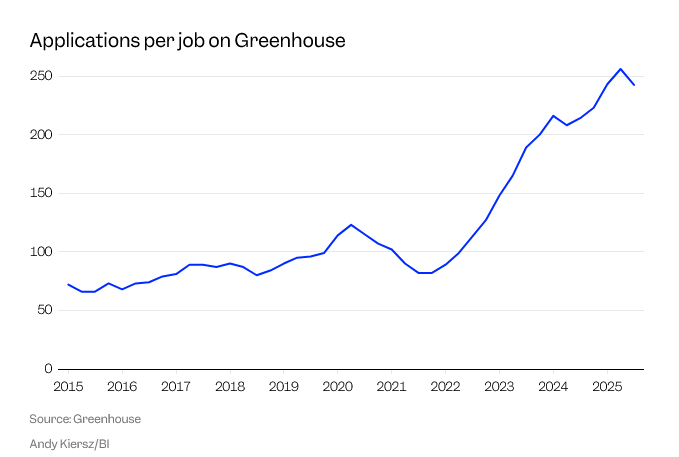
This has created a mutually-enshittifying feedback loop: Unable to land jobs, people start applying for more jobs. Unable to process all the applications in an efficient way leads to slow hiring times. To facilitate faster hiring, companies started posting “ghost” jobs, either keep filled posts on the board, or posting not actually open positions to build up a storehouse of candidates for when a job opens.
Between these ghost jobs that are never filled because they don’t exist, and the general failure of HR or recruiting to contact anyone that doesn’t make the AI cut, most applicants won’t hear back from any of the jobs they applied for. Not even a thank you. Which really says something about automation: These companies are so stretched/removed they can’t even make time for a perfunctory, wholly computerized/empty sentiment. More than 98% of online applications don’t receive a response.
"The forces that make it cheap to send more applications are working faster than the forces that allow you to quickly process many applications," said Alvin Roth, a Nobel Prize-winning economist at Stanford who's helped design programs to better match students with schools, organ donors with patients, and hospitals with new doctors. "We're deep into congestion... marketplaces have to fight hard to defeat congestion."
Elevator in State of Free Fall
This only makes job applications seem more hopeless.
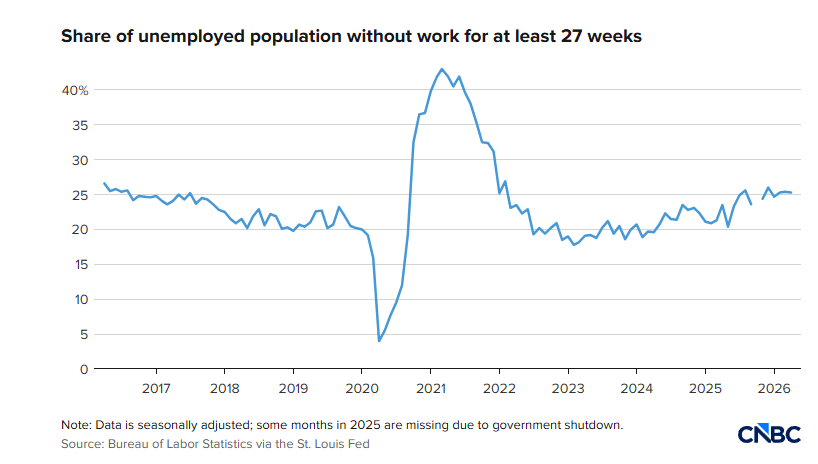
To be fair, it may only have changed in the nature of its hopelessness, not the character. Jobs still must be filled, even poorly. Right now about a quarter of all the unemployed are long-term unemployed, unable to find work for at least 27 weeks. That’s not running far off it’s traditional rate, though it is climbing. The average time to be unemployed is 25-26 weeks. It was 13.8 in 2006 and 29.2 in 2016.
On top of the never-ending corporate job trawling, hiring has become a risk-averse war of attrition involving multiple rounds of interviews. It now takes 20 interviews versus 14 in 2021. The average time to fill a position is now 42 days, It was as low as 28 days in 2010 but reached 71 days in 2019.
So we are clearly not at a high-water for this phenomena, but we’ve passed a threshold. Companies still have to hire – they have work to be done. But increasingly they’ve turned away from job boards and are choosing pretty much any other alternative.
For those using job boards, the prospects are rough. Just 2% of job board applicants get an interview and just a quarter of the resumes ever find human eyes. Not only are most open jobs filled through networking and referrals (>80%), but 70% of available positions never get posted. Talk about “ghost” jobs!
This means you have to sent 50-100 applications to land one interview, and that number is probably low. The numbers keep climbing too! Volumes may be up by almost a quarter over last year, while even less are making it past the initial screens.
“Nobody's happy with the current situation," says Greenhouse CEO Daniel Chait. "Something broke in the technology."
Only it’s not actually “broken,” it’s structurally overwhelmed, and nobody's building a replacement.
There aren’t a lot of alternatives for employers or applicants. Those in more specialized industries have outsourced the job to recruiters or moved to specialized and niche job boards to pare away the volume, and presumably find better matches. The problem is actual recruiters are quite expensive, though there is value in better retention rates.
Essentially the sheer volume of candidates have forced companies back toward gatekeepers and smaller, bespoke answers because they weren’t getting good ones from the AI-engineered resume and keywords search systems, which they still can't quit. The people who win that contest are the ones working hardest to juice their resume with keywords. That may be a poor indicator of quality. (See again, GIGO.)
There are a lot of groups offering their own “better” technology fixes, as though trying to answer difficult questions with greater (already inadequate) automation isn’t what put us in this position in the first place.
This is Where the Answer Would Go
But there isn’t a good one. Job Boards are pretty close to useless, but what’s the alternative?
One article suggested stalking the HR staff of companies and making contact with them. What could go wrong with that? And networking? People can’t even make decent friends anymore, do we really need to ladle more maybe-you-could-do-something-for-me on top of that?
Authenticity will hardly have a chance, and there are even less answers to the collective struggle to make life less rife with performative phoniness. (See, Fake it Until I Defraud Someone.)
On the whole it feels like we need to make a sheepish, societal shuffle back, tail between our legs toward expertise and curation, which requires trust and at the very least ambivalence toward fraudulence.
The obvious issue is that on every level our American culture has rejected expertise right down to reporters trading in analysis for corporate-supplied cold takes and stenograpy. Unless we start to weed our own garden, nothing useful will ever grow here.
That means finding a way to move beyond who-you-know toward something a bit more egalitarian and merit-facing. The white-guy-I-get-drunk-with (or, play-golf-with) is a terrible way to increase productivity. Just look at what the Ivy League’s become: Bunch of weak-willed surrender pigeons. Best & Brightest? Nope, Entitled & Feckless. A short stroll from Autocratic Kakistocracy.
Until then good luck stalking your favorite HR person.