Online Dating: How Civilization Dies
Has anything of this much consequence been entrusted to the untrustworthy? (Don’t answer that.)
One allegation I will never beat is my age. It’s a blessing and a curse. Any Gen Xer has really gotten the courtside seat to America changing before our eyes. Dating is definitely a major node. Some of my first post-collegiate dates were from personal ads in the alternative weekly. I was new to town, so there was no friend circle (or “college”) to draw on. Personals were a game-changer.
I’ve moved a fair bit since then, and eventually was encourage by the bartender/owner of a Cleveland Bar called Prosperity (approximately 100 feet from my home at that time), to attempt online dating (E-Harmony). This was almost two decades ago, even before smartphones fully emerged. Almost every date was disastrous. I remember meeting a girl in a parking lot, having her walk over to my car, once me over and tell me I wasn’t her type. She didn’t even have me get out of the car!
Pretty much the only e-harmony date I ever went on that didn’t completely suck was my first date with my ex-wife, and that sucked too, since she was convinced I had a thing for the waitress (see also, red flag). When I started dating via app again, some 14 years later, after a dozen years of marriage, I got laid a few times, but mostly found online dating to be miserable.
I went on a fair number of dates, probably 12-15 over the course of four years. I had probably five times as many conversations that went nowhere. I tried at least a half-dozen apps. I came away feeling like there had to be a better way to meet people. And I have to admit, I’ve only had a couple dates emerge from the numbers I’ve scored going out to bars and nightspots, trying to meet authentically.
So rationally, however distasteful, online dating has better odds. But I couldn’t shake the sense that it was a road to nowhere.
The Comcast Ethos of Service
I am not the only one. Online dating’s worn out its earliest adherents. A Forbes survey last year found a lot of burnout with more three-quarters reporting at least some burnout, led by Millennials with Gen Z and Gen X bunched close behind.
A 2024 study which followed hundreds of app users for three months found "burnout across the board." Just still being on the app after three months can feel like failure to the user (though not to the app's maker). Studies link dating apps to higher rates of depression, anxiety and loneliness, striking those already struggling to address those issues hardest. (Need hope? Meet dating reality.)
Liesel Sharabi, director of the Relationships and Technology Lab at Arizona State University, aggregated 17 years of studies on dating apps covering 26,000 people and found those using the apps reported significantly worse psychological health than non-users. FOMO seems to be a driving aspect aping the addiction of a slot mahine, promising a payout just another pull away.
"There's this feeling that the next person you swipe on could be the person you end up marrying," one woman told a BBC reporter. "There's this endless hope that it feels like dating apps prey on."
While dating apps enjoyed a boon during the pandemic, most sites have been shedding users since – which is also kind of extraordinary because many of them are free! In England, Ofcom reported in 2024 a decrease in the numbers on Tinder and Hinge of 3%-5%. In a 2024 letter Match told shareholders that users were looking for “lower pressure, more authentic way to find connections.”
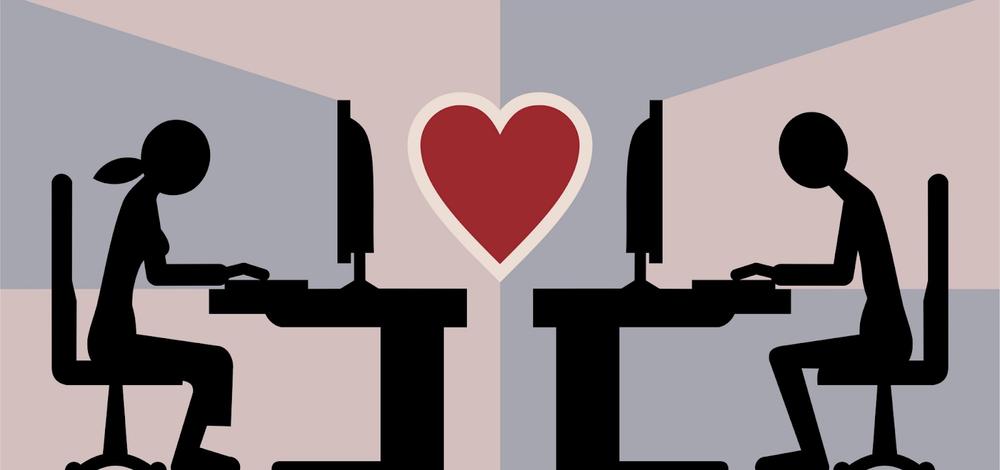
People spend on average of 50 minutes a day fidgeting with online dating, or about 300 hours a year. For comparison, we spend 50 hours a year volunteering,5o hours shopping, 100 hours exercising, and about 90 hours reading for pleasure – collectively less time than we spend online dating, and that’s not counting the dates!!
That’s a lot of time for a seemingly meagre return when, if you think about it, you could dedicate that time to doing something you actually enjoy, and possibly meet someone with similar interests that way. It’s not nearly so pro-active, but I think we too often error on the side of trying to control things beyond out ability to influence with any consistent or reasonable return-on-investment.
Part of the obvious issue is that dating apps are like drug reps – they want you to keep using their product until the day you die, which is not the incentive structure everyone has for dating. Many who have dated will attest how much they enjoy their time outside the dating pool.
Who Peed?
A lot of what happens in the dating pool isn’t great.
Most women have reported unpleasant experiences, from stalking to scammed out of money to being verbally abused. A Pew poll from 2024 found that women saw dating apps as an unsafe way to meet people by a 53% to 39% margin. Not coincidentally most sites don’t do background checks on free users. (This has led to a number of attempts to gatekeep and limit male users, teasing socio-economically tiered dating – just like real life, only more so.)
While the dating apps have an obvious investment in keeping users swiping, that’s not the only thing tilting the odds. Dating sites all generally have twice as many men as women on themwith some reaching more than 70% male. This disparity means women are getting a lot more attention than men, and have a lot more cause to be picky. A New York Times story from 2014 reported that women liked 14% of the Tinder profiles they saw, while men liked nearly half (46%) the profiles they saw!
For a while a meme has circulated connected to the Pareto Principle that the top 20% of men receive 80% of women’s attentions. This was based on an inaccurate post about OK Cupid from 18 years ago and it still has legs because it rings true enough. According to a Hinge engineer referenced in a Medium post (with a dead link), it’s more like 50% of the women likes go to the top 15 % of men, and 50% of the male likes go to the top 25% of the women.
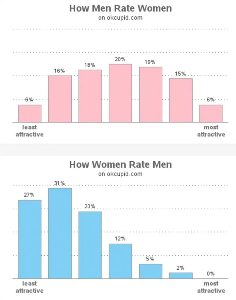
Even more distressing given the focus on looks, is that according to OK Cupid, women rated men’s looks very harshly with around 7% rating as better than average and 81% as below. Now obviously women are much more likely to consider factors outside looks than men, but most apps are built to accent the beauty contest aspect, and amplify the game of swiping.
The tendency to gamify dating and normalize the idea of short-term coupling has conceivably driven a great deal of dissatisfaction. An international study of 6000 people across 50 countries, found less happiness among partners that met online.
“Participants who met their partners online reported lower relationship satisfaction and intensity of experienced love, including intimacy, passion and commitment, compared to those who met offline,” Australian study co-author Adam Bode said. “The internet provides access to a seemingly limitless pool of potential partners, but while this abundance could help individuals find an ideal match, in practice, it often leads to choice overload.”
Given all the possibilities, many find it harder to commit. While people on dating apps report wanting committed relationships about half the time, that’s not always the reality.
In the end, many people wind up in a sexual relationship, perhaps feeling pressured by their relative replaceability. A French survey reported more than half couples state having sex less than a month after meeting online and a third had sex when they’d known each other less than a week.
New Norms, Higher Expectations, but Same Old Roles
On the other hand, let’s give weight to the other possibility that the relatively recent myth of romantic love is taxing of its own, especially the sexual double standards to which women are subjected. Some clearly appreciate the opportunity to pursue a self-identity different than the one they show their friends.
In a 2022 article in the Guardian, Dr. Marie Bergström argued that online dating is part of a changing culture around love. Where once one found a partner among friends, colleagues or acquaintances, love is a much more private, easily compartmentalized activity these days.This too has downsides.
“Online dating makes it much more private. It’s a fundamental change and a key element that explains why people go on online dating platforms and what they do there – what kind of relationships come out of it,” said Bergström, whose 2021 French book, The New Laws of Love: Online Dating & the Privatization of Intimacy, courted controversy.
“In the western world,” she said, “courtship has always been tied up and very closely associated with ordinary social activities, like leisure, work, school or parties. There has never been a specifically dedicated place for dating.”
She worries this is another brick in an increasingly insular world lacking in social cohesion. She found users mostly sought those with of similar social class and ethnicity. “In general, online dating platforms do not break down barriers or frontiers. They tend to reproduce them.”
While initially there were indications that online dating helped destroy old hierarchies, particularly interracial dating,the evidence is mixed. A 2024 Canadian study found no difference in interracial coupling compared to those introduced by friends or family.
It did find people tend to date people the same age, and women were more likely to date men with more education,which is an interesting data point if it holds in the U.S. where the loss of the kind of blue collar working class jobs their parents once held has driven middle-aged men without a college education out of their minds. One study found men with above average education and interest received three times as much interest!
Ask Again Later
There isn’t an easy answer to any of this. We as a society systematically kept women down for hundreds of years and gave them “jobs” (see, breeding, cleaning, child-rearing) without pay so they couldn’t fend for themselves. We foisted an idea of Mr. Darcy on them and widened their eyes with romantic fairy tales, so the medicine would go down easier. Then burdened them with an impossible beauty standard and a madonna/whore complex, to sap their self-confidence.
We’ve finally taken steps to afford women the agency we so long denied them, and men in positions of power don’t like it. But rather than do anything directly, they’ve gathered up all the un-dateable men under this self-loathing incel flag (see, also, Twitter/X) that makes men somehow the victims rather than unsocialized clods who refuse to dig any deeper into their own culpability/mediocrity. (See also, Entitlement.)
Meanwhile. women are finding a lot of men resent their newfound freedom. At the same time they can sometimes seem more consumed with checking a mental list and keep their powder try, while waiting for something rare to cross their transom. When the truth is many of the men crossing their transom maybe can’t market for shit.
After not having a lot of choice, women are taking advantage of their freedoms. (Go Queen!) Men are having to give up a small sliver of their privilege but whinge as if this is an intense loss, which, to be fair, it is for the undateable men. Yes, women are pickier, but men are sucking more (a reaction to women's increased agency), and, worse, are too entitled to believe it's an issue.
There was a time when uneducated but hardy morons could find workaday work in a factory or what-not even if they were a huge dumbshit, pain-in-the-ass. But America doesn’t have those jobs anymore. Shamed by their own belief in manifest destiny – i.e. if I’m unemployed I must really be a loser – they externalize those feelings of societal rejection onto women as a whole. ("She didn't like me? Must be a man-hating lesbian!")
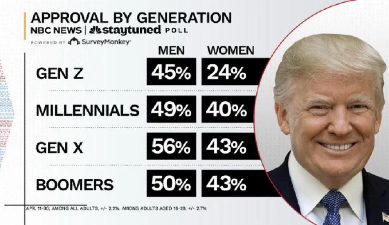
So on some level, the globalism (empowering China, but other third world countries as well) which shut down America’s factories, spawned an entire generation of despairing males (Hi Gen X, you fuckheads!), unable to find the locus for their real pain, and more than willing to indulge the streetlamp effect to blame it on uppity women who won’t abide/indulge their pot-bellied, mommy fantasies.
Is this just natural selection asserting itself through diminished fuckability?
Obviously this is a run-on over-generalization, and to properly examine it would take more time than I am willing to give this separate issue of assortative mating, in a piece ostensibly about the curse of online dating.
The larger idea is that much like the billionaires, who could’ve kept cashing the checks but decided they wanted to end democracy, high-status men got frustrated they couldn’t rape and traffic vulnerable women to their heart’s content, and absolutely could lose social status if they sexually abused their coworkers, something men of a certain status thought was their divine right. (“If you’re famous they’ll let you do it,” Trump ham-handedly explained.) So they paid (see, Twitter/X) to rile up the incels (see, "victims") to utilize as a misogynist army.
While those fart-sniffing neckbones won’t be missed, there is a real issue here. Coupling is essential to the entire species and we’ve left it in the hands of some tech bros trying to milk people they don’t know (like most of us) for all they own.
Beyond even the present generation of Online Dating Apps which seems to be sowing the seeds of their own destruction with Waymo Autonomous Tractors, we are a culture that has long treated women as second-class citizens. This has resulted in a bevy of social gender roles (who pays, for example) that are much slower to change than the underlying circumstances. According to some, gender roles' evolution plateaued two decades ago.
We’re left with roles that don’t fit either side, difficulty discussing our values with people we hardly know (yet, obviously!), a bevy of social propaganda only trying to monetize lust or endless pursuit, and not nearly enough low-key, easy-going, who-knows-what-will-happen-next-what’s-your-hurry.
Given how malleable moods and emotions can be in the overstimulated boxes we call our heads, it would probably be helpful if we all had more patience, and particularly grace for those we date. I made a rule ages ago that I wouldn’t judge someone on a first date. Not sure that worked, but I still feel the concept is sound.
Finding love, or fascination at the least, is – for many of us anyway – something that happens rarely, and that anticipation and disappointment is the savor. Savory turns bitter after time, but maybe it’s all about putting stuff in the fridge, being like Fonzie, and allowing life more leeway in its crooked course.
For so much of our life here we had no use for clocks. Little wonder they vex us so now.