Cheesecake Factory & the Last Great Circus
Metal Detectors Arrive On Shore of Women Sports' High Tide
We interrupt this laudatory piece about our local women’s soccer team, MN Aurora FC, for related breaking news.
Have you noticed the vampire squids poking around the Cheesecake Factory? Industrial hoes tilling fertile women’s athletics, at a moment when live sports is the only place advertisers will plant their money.
Speculative cartels emerge daily, such that World Foosball Tour, U.S. Bocce Federation and Kickball365 execs are enjoying expensed steak dinners like indie rockers post-Nirvana. This year ESPN+ broadcast the inaugural season of American curling, the Rock League. (How has Dwayne Johnson not turned that into an endorsement deal?)
It’s probably all the more attractive because it’s women’s sports. Hard to imagine anything wealthy men cherish more than profiting handsomely off women’s labor. (On some level, women entering the workplace is what allowed Volker to aggressively raise interest rates.) The difference between investment and colonization gets much blurrier when you’re gatekeeping participation.
The best way to bring home the difference is to compare it to European soccer leagues where teams are owned by communities (or Ryan Reynolds, I guess) and can rise through promotion/relegation to the very highest level. Nobody decides the caliber of the city’s team based on how much the owner’s willing to drop. (Cough, NSFW, cough.)
As Tim Worstall explained in Forbes 14 years ago this differentiates a league where excess profit flows to players and communities, not maximalist profiteers and rent-seekers. (This is also way European soccer teams are always going bankrupt.)
(To be clear, professional sports were not always seen as a great investment nor have they always enjoyed such dramatic value growth, which emerged thanks to digital era advertising changes that increased competition for shrinking attentional bandwidths.)
That's part of how what could be a paean to another great Aurora FC season of near-pro, (more on that in a moment) women's soccer turns into a much longer piece on the changing fortunes of women's sports and who's seeking to capitalize. (TL;DR: Capital, duh!)
Because if there’s one thing a vampire squid can’t resist, it’s more.
Aurora Fall Short Again
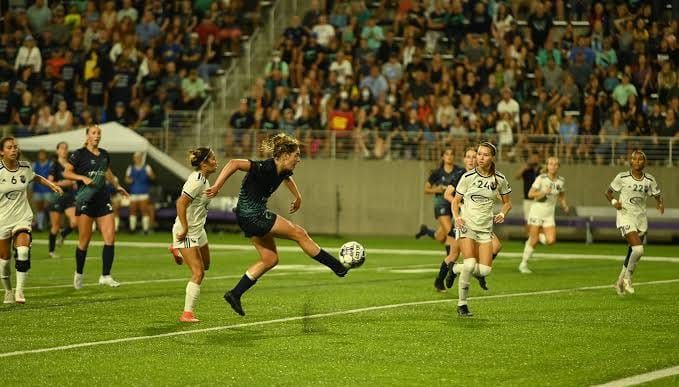
In their fifth season, the Aurora have been a runaway success by almost any metric since playing their first game in 2022. They've not lost a regular season game, going 55-0 with five draws. They made it to the League final their inaugural season, the conference finals the second, and after an embarrassing first round exit in 2024, have made it to the semis the last two years.
This year was particularly vexing. They not only won every regular season game but after winning two playoff games in Pittsburgh (Union FC Macomb, Pittsburgh Riveters SC) had to fly to Seattle for the Semis where they lost. This despite the fact the Aurora lead their league in attendance with around 5518/game. (USL-W playoff seeding is not based on record unlike most sports leagues, and isn't transparent on the factors.)
Their remarkable run of success is even more impressive given the constant turnover. Much of their roster is just out of college or not far removed, and as such must balance development with winning, and start from scratch each year. The results speak for themselves. Team attendance is the best in the league, making the lack of a playoff game that much more vexing.
The attendance reflects a twin cities community that appreciates soccer (19,000 attend the local men's indoor soccer league games) and is a fervid supporter of women's sports. Indeed, the team was literally community owned, funded by an inaugural 3000 members and has grown now to over 5000, whose monies have funded the team until now. (More on that in a moment.)
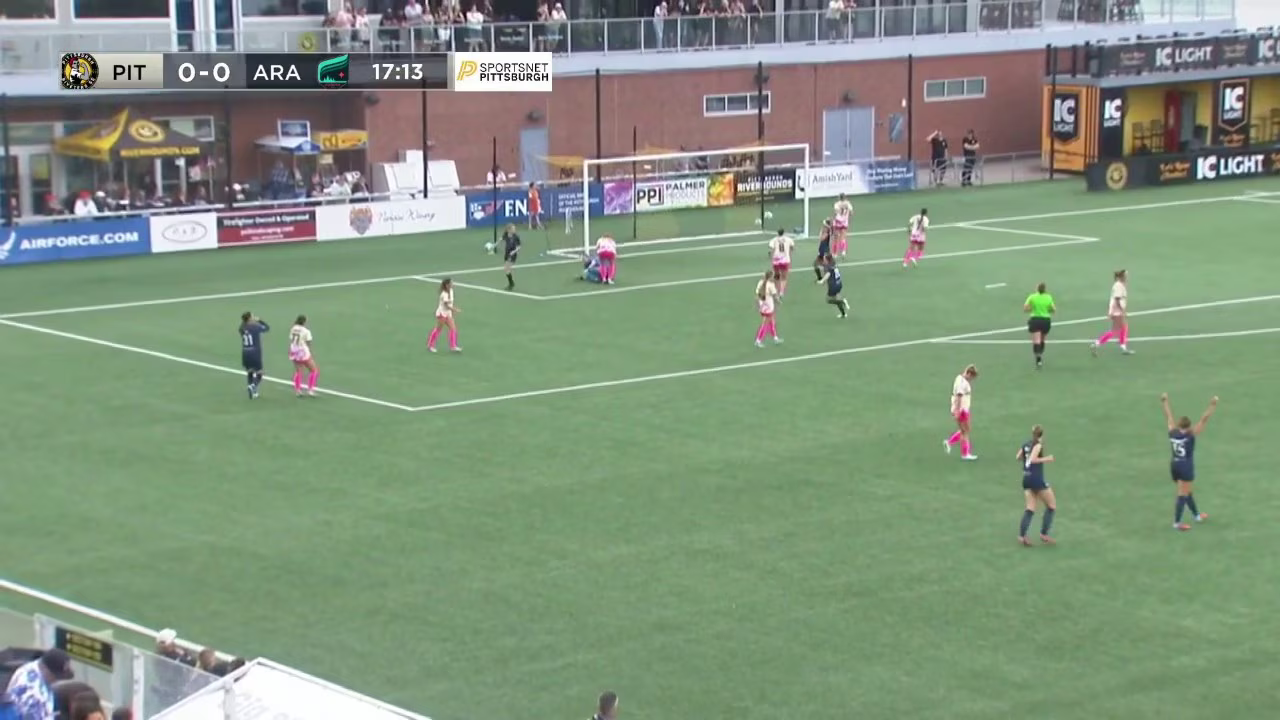
After beating Riveters SC 2-1 when Flavie Dube found Gracie Dunaway for a sliding kick past the goaltender in the final seconds of extra time.
Last Saturday's game came down to mistakes. Anna Menti of Salmon Bay thought they had earned a goal kick, but the ball never crossed the end line. Menti touched the ball with her hand to set up the kick for the goalkeeper, and was whistled for a handball in the penalty area. Ai Kitagawa scored on the penalty kick to give Minnesota the 1-0 lead.
Salmon Bay FC tied it in the 89th minute, after Aurora goalkeeper Taylor Fox received a yellow card in the penalty area colliding with a Salmon Bay player while going for a loose ball. Salmon Bay converted penalty kick and then won 3-2 on penalty kicks after the game ended in a 1-1 tie.
Ante Up and UP AND UP
In 2024 Aurora made plans to apply for a 2026 NWSL pro franchise. They even had the required single backer with at least $15M in wealth and 35% ownership. But this unidentified backer begged out at the last minute. He missed out on what's become an extraordinary gold rush, whose exploding economics mean the twin cities either dodged a bullet or missed a chance to throw reigns on a comet.
Since the Aurora limited buyer backed out, the price of admission has gone up. On Saturday the Denver Summit FC played their inaugural game in the NWSL after paying a $110M expansion fee. The San Diego Wave, who paid a $2M expansion price in 2022, were sold in late 2024 for $120M. And maybe they sold too soon. A few month earlier, the Los Angeles team, Angel City FC, sold for a quarter of a billion to Willow Bay, (Disney's) Bob Iger's wife.
The Current who paid a $5M expansion fee when they moved from Utah to Kansas City sold for $141M, and the KC deal came with a privately-funded stadium. Since opening the stadium it has the highest revenue in the league. Atlanta paid $165M for an expansion team, and most recently the Haslam family, which own the Cleveland Browns and the MLS' Columbus Crew, reportedly paid $205M for a women's expansion team that will share the Crew's stadium.
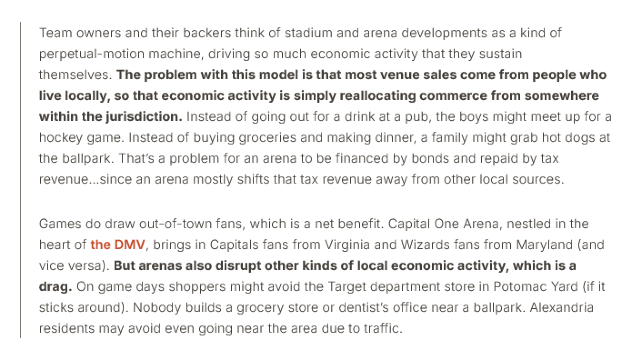
(Side Note: Stadiums are terrible deals for everyone but the owners in 90% of the cases; they rarely meet expectations financially and to the extent they do, that growth is leeched from the neighborhoods beyond the stadium, as the Bloomberg except below explains. Public funded stadiums have evolved through owner leverage into a toll on having nice things.)
The Aurora's stadium in Eagan is the complex the Vikings use during training camp. so there's some sharing issues, but more than that, it's not owned by the team and it both costs rent and isn't throwing off money from associated deals with the neighboring entertainment establishments. This also figures into valuations.
“Revenue multiples for leagues are informed by real-world transactions,” Sportico valuation expert Kurt Badenhausen told the Athletic last year. “It’s not necessarily linear all the way down the line because a big-market team in a brand new stadium is different from a team that plays in a small market and needs significant investment in their facilities.”
This is also represented in the fact that many of the NWSL expansion teams have cushy stadium contracts or deep-pocketed owners, like Iger & Bay who promised to invest $50M in the Los Angeles franchise. The success isn't distributed evenly. Given the sums involved, it's hard not to imagine NWSL teams changing hands and locales in the coming years. (That's the downside risk of joining NWSL outside a coastal media hub, absent a cushy stadium deal. Sometimes the universe is telling you something.)
“Certain franchises in the NWSL have struggled to maximize their business opportunities, which is no different than any young sports league," Badenhausen said. "The same dynamics play out in mature sports leagues, such as the Athletics and Rays in baseball over the past decade or Arizona’s NHL franchise.”
One remembers that there's typically a lot of movement during the early years of a sports league. The WNBA began in 1996 with eight teams and grew to 16 by 2000. Only four of those teams remain, Los Angeles, New York, Phoenix and Los Angeles.
Tumult is a common theme in a new league, though things have changed dramatically since the WNBA's formation. To put it in perspective – the WNBA just approved three new expansion teams (Cleveland, Detroit, Philadelphia) at $250M apiece, not much more than the Haslams paid for their NWSL franchise. The treadmill's moving faster, driven by the explosive growth of women's sports coverage.
“Women’s sports sit on a very different growth curve from mature men’s leagues,” said Theo Ajadi, assistant director at Deloitte’s Sports Business Group. “That’s where many investors see long-term upside."
Big Media Contracts For Last Great Circus
Live sports is where it's at because it's the only place viewers can't time-shift or skip commercials, and that's big in advertisers' minds. Networks last season aired a record low 51 scripted series, a 45% drop from the pre-pandemic 2018-19 slate of 92 on ABC/NBC/CBS/FOX. Meanwhile sports' share of total TV ad spending has increased from 14% in 2022 to 23% in 2026 to an expected 27% in 2030.
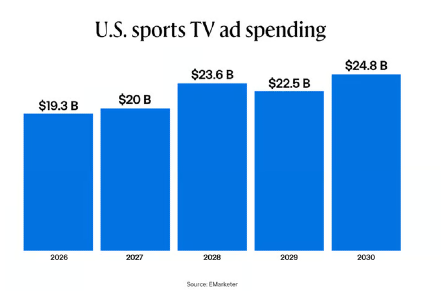
That long-term growth curve has run into two back-winds, the move among all platforms (but especially networks) away from scripted shows and toward lower cost reality TV and live sports, the place increasingly advertisers prefer to spend their money. That's an $87B market, nearly a quarter of it spent on sports (and nearly 60% of that on football!).
That's what justifies these valuations; that and the stability of sports team returns (from games to broadcasting to merch) thanks to the scarcity of the product and loyalty of the fans. (Season ticket renewals in sports are over 80%; merchandise is surprisingly durable compared to team records.)
But it's also demographics. People in the prime 18-49 demo only made up 12% of the Four Networks' primetime deliveries in '25-'26. People watching Sunday Night Football were 33% that prime demo and SNF drew 6.85 million viewers whereas the entertainment average for the season was 400,000. While television ad spending is expected to grow by 6.6% through 2030, sports ad spend will jump by four-times as much, an estimated 27%.
Indeed, football is such a money sponge that 90 of the top 100 Nielsen broadcasts last season were college or NFL Football. The NFL accounts for 46% of the TV Sports ad spending, and if you add college football it reaches 57%. Basketball is next with 11%.
It's not only that live sports is the only thing advertisers will invest in; that's been true for a while, and justified the huge deals for the NFL ($12M/yr), NBA ($7.6M) and MLB ($1.2M). But as mature assets, their potential return is pretty cooked in.
Girls Got It Going On
However after years of ignoring women's sports, broadcasters are finally tuned into the explosive growth, paid for in part by US policy, i.e. Title IX, which tried to assure that female collegiate athletes were funded like the men.
“We’re still early,” said Lorine Pendleton, Founding Partner of 125 Ventures. “Women’s sports have been historically under-capitalized. What we’re seeing now is professionalization.”
The early returns have been gobsmacking. Women's college basketball saw 33% year-over-year (yoy) viewership growth, and the NCAA Championship game drew an average of 9.9 million, the third highest women's championship in history, though still down from the 18.9 million that watched Caitlin Clark in 2024.
It's really all women sports. The Women's 2026 Winter Olympic gold medal hockey game between Team USA and Canada average 5.3 million viewers. The NCAA 2026 Women's Volleyball Tournament averaged 666,000 across 15 matches on ESPN, up 13% yoy. The 2025 US Open Women's Tennis final averaged 2.4 million on ESPN up 50% yoy.
Meanwhile the NSFW saw a 61% increase in average viewership during last year's season. This undoubtedly prompted the mid-contract renegotiation of the 4-year/$240M contract signed for 2024-2027. It led to ESPN/ABC nearly doubling their coverage, CBS adding 17 matches and Amazon Prime adding 25 exclusive Friday night matches, and a new company paying for Sunday streaming broadcasts.
“We are expanding the discoverability and reach of NWSL matches because the demand is there,” said NWSL Commissioner Jessica Berman in a statement. “These additional media packages will help us reach new audiences and build a new generation of fandom. The expanded commitments from CBS Sports and ESPN, paired with a new national Sunday night showcase with Victory+, bolster the NWSL’s trajectory of unprecedented growth.”
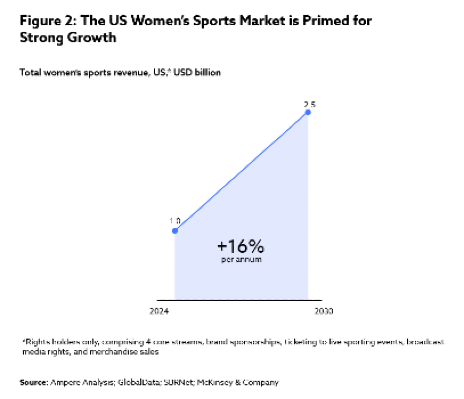
According to McKinsey, women's sports have the potential to generate at least $2.5 billion in value for rights holders in the United States by 2030. Another study from Bank of America saw outside revenues for women's sports jumping by 250% to $2.5B in four years, including sponsorships, merchandise, social media and other categories.
ESPN recently signed a three-year rights extension with Athletes Unlimited to be official partner of the company's softball, basketball and volleyball leagues. Old school media company E.W. Scripps announced the Scripps Sports Network, a free ad-supported streaming channel launching with 100 live events per year across leagues, including the NWSL, Professional Women's Hockey League and Major League Volleyball.
This month the premier Women's Baseball World Cup occurs in Rockford, IL and not far away in Springfield, IL next month the Women's Professional Baseball League starts with four teams playing a month-long season followed by a two-week playoff.
It's not just America. The 2025 Women’s Rugby World Cup in England was the biggest and most attended women’s rugby tournament in history, while women’s cricket in India is on a growth trajectory and could see more commercial interest with its inclusion at the 2028 Olympics in Los Angeles.
Following the WNBA's Lead
The runaway success of the WNBA is the template for women's soccer, but with an even steeper ROI slope, thanks to the aforementioned reasons. Also this year's men's World Cup has helped catalyze interest in soccer, and the US Women's team is one of the most dominant in the world, with five fold medals in the last 30 years, and three World Cup titles in that time, though they failed to defend their back-to-back titles in 2023. (The Women's World Cup will be in the Americas in 2031.)
Though small compared to football, the 1.3 million viewers ESPN/ABC averages this year is up 6% and Amazon Prime's games are averaging half a million. However that growth also demonstrates that women's basketball is in a slower growth phase as a product, if not in valuations.
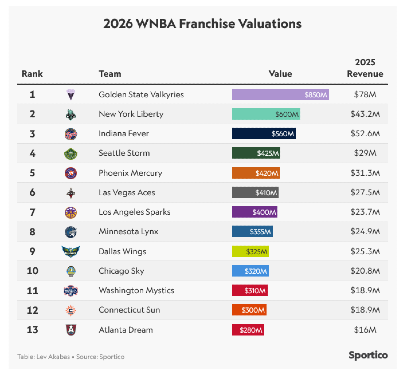
The average WNBA franchise is worth about $460 million, the average NWSL team is worth $184 million that's a 275% leap from 2023 average valuation of $66M. Meanwhile the WNBA has grown from an average valuation of 96.7 million in 2024, a 475% jump that exemplifies how fast valuations are moving compared to other metrics like viewership and attendance (+6.6% yoy).
“The WNBA’s growth is important because it changes the baseline perception of women’s sport. It signals to investors, sponsors, and media partners that women’s sports are credible, scalable and commercially viable,” Katie Lebel, a sports business professor at the University of Guelph in Ontario, told the Guardian. “On one level, this is a market correction. For years, women’s sport properties were undervalued relative to their audience, cultural relevance, and growth potential. What we’re seeing now is investors catching up. They’re pricing the future value of women’s sport rather than judging women’s sport properties as risky investments based on limited past revenues.”
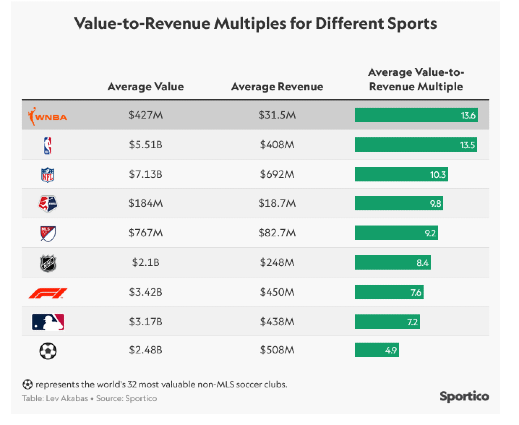
"It’s about market size, scarcity, growth trajectory, and the strength of the business model," Lebel continued. "Women’s sport is in a high-growth phase right now. Their audiences are expanding, investment is increasing, and there’s a strong cultural tailwind. In contrast, men’s leagues are mature assets, so they have slower growth."
How's This Play For Aurora FC?
Unable to score a birth in the NWSL, the Aurora could remain in the USL, a "pre-professional" league which formed in 2022 and has grown to 96 teams across 16 divisions. Yet this obviously feels a bit like spinning its wheels under the circumstances. The scuttlebutt is the Aurora may move to the Gainbridge Super League, a professional league which broadcasts on Peacock and formed in 2024.
The Super League presently features eight teams in an odd Fall-to-Spring (see, Europe) schedule initially designed to separate it from the NWSL, but it will only play a "Fall" season this year before resetting to the American spring-to-fall soccer schedule that allows them to add collegiate players to start the season and better align with the NWSL, which would better facilitate player loans according to ESPN.
(As someone unfamiliar with soccer it was delightful to learn teams essentially sublet players, this is also indicative of Super League's somewhat subordinate position, even if sanctioned at the same D1 level.)
There has allegedly been discussion of a year-end cup series beginning in 2028 between the Super League, NWSL and the incipient WPSL Pro second division, which begins play in August with 16-20 teams and a $1M franchise fee while seeking to bridge the talent space between USL and the two pro leagues. It too will be moving to a spring-to-fall alignment next year. (The NWSL is also planning a second-division league.)
As the Super League abbreviated season is just starting it's obviously too early for Aurora FC to speculate about joining the league for 2027. Though there have been no announcements, word is out that they plan to expand to a 12-team configuration.
Besides Minneapolis, possible expansion teams have been mentioned in Rogers, AR, which has committed to building a new stadium complex for the Ozark United team, and the New York (Jersey) Cosmos, who play in a revitalized (by $110M) Hinchliffe stadium in Patterson, NJ. Boise and Des Moines, IA are preparing to field teams in 2028, once their new stadiums are finished. Other current USL-W peers of Aurora linked to moves include Oakland, Indianapolis, and Chattanooga.
Load Up on Garlic?
Not going to get too deeply into it here, but lot of private equity investment in sports. They can smell a good return and will swarm. Between 2019 and 2024, private equity firms invested more than $55 billion into sports-related assets, spanning franchises, leagues, media rights platforms, data and technology services, and fan engagement‑businesses.
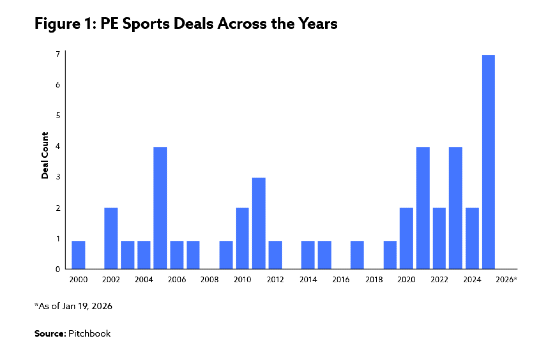
In the last decade the major sports have opened themselves open to private equity ownership and as of December, more than 74 North American professional teams had some level of private equity involvement, reflecting the appeal of rising franchise valuations and demonstrating the growing role of institutional capital in ownership structures once dominated by individuals as these franchises advance in value.
“As these valuations rise, the ownership model naturally changes,” said Ajadi. “It becomes harder for a single individual or family office to provide liquidity, fund large capital projects, and manage concentration risk on their own.”
If there's anything the last quarter century has taught us, it's that private equity (hereafter PE) is bad news, from Other People's Money to The Wolf of Wall Street and the Big Short, we've been living this truth for 40 years. The rise of the Tech Bros and those luxuriating in the eau de toilette of their own farts only amplifies the concerns about the sustainability of these ratcheting sports franchise valuations.
That said, women's sports have been chronically underfunded for years and hardly televised. Just like the late-seventies and early-eighties, a lot of rich men have the opportunity to capitalize on underpaid women at a moment when the returns on male athletics are getting squeezed by player salary demands and their mature state in a rapidly expanding world of sports offerings driven by ad money looking for the best place to roost. That place was once newspapers. You've heard of them, right?

There will come a point of diminishing returns for televised sports. But women are a huge, often neglected television audience and they enjoy women's sports. If the bubble bursts, it doesn't seem as likely to puncture the fastest rising segment of viewership in the sports firmament, whose novelty is only part of its appeal.
We didn't intend to spend this much time talking about the end of the Aurora FC season, but it lent itself to discussing this strange but very obvious phenomena of sports valuations. We couldn't be happier to be a part of a community that supports women sports so profoundly, but we can't help but notice how things are going and wondering where the fickle pursuit of eyeballs will lead next ad dollars next, and who might get hurt by the philandering.