Tolls on the Road Less Traveled (Be True To Your School)
What is valuable and where do you find it? Why do you want it? How readily can you acquire it? What happens after you have it?
These are intensely personal questions that shape how you live your life, but they mostly exist in the background. They inform your choices but aren’t usually a part of your daily life. Most people – and to be clear, I am not among their number – don’t walk around a lot pondering these things moment to moment, or if they do it’s more of a sudden thing because they’ve been displaced in some way.
It would be decades before I would understand what it meant to be neuro-divergent and was diagnosed with ADHD. But I was definitely a high self-monitor whose friends kept trying to counsel not to think so much. As if I hadn’t tried that.
My parents had me in grad school and I spent my youth hopping around from one academic post to the next, only once before high school spending as many as three consecutive years in one place. I was a chronic new kid. While I was forced to learn to be at least social enough to make a handful of friends, I was also always getting into fights with bullies because I don’t back down and they hadn’t learned that yet. As a result I spent a lot more time in the principal’s office than a kid with my grades typically would.
I was as a lone wolf before I knew what that was or why. As a latch-key only child with twenty-something parents I was obligated to entertain and attend to myself. It gave me great independence and self-responsibility. But I never got great at social cues between spending so much time in my own head and my more limited social experience. I didn’t even have relatives. (In my twenties I made several female best friends both because I was a momma’s boy, and to learn better social/emotional IQ.)
When I discovered the existence of punk – via the Let Them Eat Jellybeans comp – it was like a whole world opened up. Everybody around me was so conforming. While I didn’t know what I was, I knew what I wasn’t.
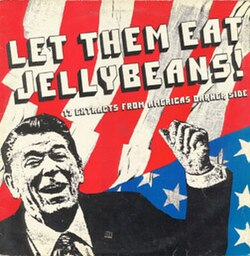
That was the first time it occurred to me there were other angry alienated people in the world, not just burn-outs. Like a lot of over-intellectualized early 20-somethings I couldn’t believe the system was so broken and corrupt. In particular, Reagan was against everything America stood for but most just didn’t get it. (I lived in Florida, what did I expect?)
As I moved into my mid and late-twenties I began to realize that I couldn’t dull my anomie and boredom for longer than about two years or so before I lose interest so hard it becomes increasingly difficult to stick with any job. As I say, I had no idea about ADHD, just realized no job I was going to get was going be interesting enough for me to stick with it.
So I worked office temp for a decade while I built up my writing skills. As the nineties closed I moved to New York City (okay, Union City, NJ) and there got one of the only two full-time jobs I had since 1992. (Don’t even get me started on how that makes applying by application impossible.)
In hindsight, it’s possible I could’ve found something that would’ve interested me deeply enough to draw me in, but those opportunities really didn’t present. This is a person who has moved to another city hundreds if more than a thousand miles away where I knew nobody eight times in my life, and I was married and in one place for 12 years. While it always kind of sucked, the promise of new experiences and the lack of fear made it possible; sometimes you leverage your ability to withstand something in the absence of actual creditable assets.
While there’s no doubt you bring your baggage with you (any other sidewalk, it’s the same old cracks), every new place is another reset. I will never forget hearing Sharon Stone talking about what a zero she was in high school on the David Letterman show, and how she realized nothing stopped her from remaking herself but her own preconceptions.
There’s a line from Elliot’s The Wasteland I never forget:
I have heard the key / Turn in the door once and turn once only / We think of the key, each in his prison / Thinking of the key, each confirms a prison
We hold our own selves hostage to demands we could never satisfy.
I was in gifted classes and I had a perfectionist father whose malady infected me for a while. There’s a great line in Joe Pernice’s “Flaming Wreck” where the snotty perfectionist is lecturing the waitress about his drink order when the plane noses down. “Is it once, is it twice, is it perfect now?” We can really get caught up in the small things, amirite?
The issue with perfectionism isn’t pursuit of the ideal, for those lucky souls without experience of such people, but the destabilizing accretion of never being satisfied. Pushing yourself is one thing, driving yourself without sympathy is another. Reading Julie Cameron’s legendary tome, The Artist’s Way, I was struck by her insight that we treat our friends better than ourselves.
The proof? Could you imagine purposefully researching your own peculiar interests to spring a surprise treat on yourself? All I can say is my people pleasing side tends to be a one-way street. I’d far more readily scheme a fun surprise for a friend or romantic partner than do that for myself.
This was part of what she called the Artist Date, where you take yourself somewhere to nurture your creative spirit. An art show, poetry reading, concert, museum, etc. Sounds a lot easier until you try to do it and find yourself standing yourself up for one reason after another. It’s kinda sobering emotionally.
Like if I’m all I got, maybe I could endeavor to not necessarily act selfishly so much as give myself the kind of grace I would a friend who was having a tough time and was feeling kinda alone.
We put ourselves in this prison. And we don’t even realize it while we are doing it, or we wouldn’t be able to get away with it.
As a journalist I spent the first half of my life telling other people’s stories. In the last decade I have tried to start being present in my own, and give them the same attention. Scratch that, much more attention. Even though on this site I am curating and writing and featuring other people, the choices are all mine. The vision is mine.
I think over time I have begun to realize that the medium is porous. The lead singer of Green on Red Dan Stuart told me that music was just a happenstance. If guerrilla street theatre was happening at the time, he would’ve done that. It’s about the communication, not the how. I feel that in my own searching for a medium.
Okay, the how is important for other people. There are frequencies that we all vibrate at. Some of them have special resonance, perhaps constructive interference. If the medium fits your aesthetic presumably there would be some kind of reinforcing feedback loop. Your job on some level as an artist, should you choose, is find the medium that best drives your creativity and allows you most readily resonate with others, assuming that’s what you want.
Some people feel more authentic one way or another. Maybe that changes from over time. If you’ve invested heavily in something that hasn’t returned as you’ve liked, maybe you need to switch things up. Not being afraid of that risk is part of what makes an artist great in my opinion.
One of my favorite quotes about art – also from GoR’s Stuart – comes from producer Jim Dickinson. He’s one of the old school guys who believes the art happens while you are trying to create it, if you know what I mean. Anyway, he said, an artist can’t create anything great unless they hate it a little.
In other words, if it doesn’t make you a little uncomfortable, there isn’t enough at risk for it to be valuable. It’s the skin in the game that on some level defines the art you create. I am not a nepo baby, but I am middle class, and I do wonder if I maybe lacked the hunger other artists have.
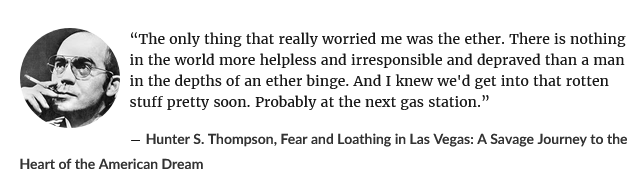
Then again, I was a self-monitorer; not a self-promoter. Someone was always going to need to discover me, and I just never knew how you really went about that, and as a loner I never really met the necessary people to maybe take one more step higher. (Or, I never – to this point – found the proper megaphone to express my truth in a greater manner. And to be honest, I’m humbled by the level of success I have already had, but that doesn't quench the desire – it's a bit like an ether binge.)
But I’m not even sure anymore what that would mean. Maybe somehow my sitcom treatment got passed to the right person? But I just had one friend in Los Angeles. I didn’t live there. Like how does that really work? Or maybe my play finds the right eyes or what not. Or maybe it was never good enough to begin with?
This goes back to a subject I’ve written about more extensively before, the idea of intrinsic value.
There’s this great line – if you see a path there already, it’s not your own. If you aren’t beating the brush away with a machete, you’re probably not going anyplace nobody’s been before. No shame there. Not only should nobody feel pressured to be innovative, just by definition, only a few are capable of breaking norms / tropes in an interesting, rather novel way. We’re mostly – as artists – mirrors to the moment we live in, or if you’re talented, a prism that enhances and sharpens some aspect(s).
In that unbelievable The Bear episode set in Amsterdam entitled Honeydew, Luca’s explains to Marcus about being young talented and cocky, only to meet a bigger fish. Echoing the old saw, talent recognizes genius, Lucca realized he just couldn’t compete with this guy. (The less noted other half of the old Sherlock Holmes quote, is that mediocrity knows nothing higher than itself.) Only after building a friendship did he realize this wasn’t a zero-sum game, that you could not be as good but still grow into something more.
The value – whatever medium of expression you choose – has to come from within generally, in the end.
Because the accolades, the money, the attention – they’re fickle and don’t always find the worthy, and certainly not in good time. Catering to seduce and secure these awards is its own kind of hell, as Carmy’s character demonstrates because there is no end. If you are doing it to cover or fill some void you will find you never stop digging.
Joe Pernice writes a song about Bjorn Borg, one of the most fascinating human beings ever, if only because it’s almost impossible for a person to give up the thing they’ve worked at their entire life when they’re on top. It’s sort of Carmy’s story. Pernice sings sounding almost like he were discussing the Fisher King from the Wasteland, saving old fragments to shore against his imminent ruin, not the goddess of perfection Aphrodite rising from the tides.
Sitting on the top of everything
Sweetly irritate what you can't leave alone
Hottest summer in a hundred years
Molten bulkhead burns your hands while you would sleep
All around her words were fading in like a cryptic dying
And we knew that what we had was nothing that we wanted
And the waves, they broke around her
And we killed the endless summer
Pray the season never ends
It slams headlong into the other one
We need only look at old fighters or TV stars to see how hard it is to surrender the stage. Those levels of attenuation aren’t for everyone. The vigilance required for excellence of that level is exhausting. That’s why so few can maintain a high level for long. As John Wooden would say, “Getting to the top is about persistence, staying there is about character.”
Another way to say it would be, getting there is about sacrifice in the service of persistence, but once you get there, it’s just more and more sacrifice. There is no plateau, just more of the same. Then it’s about who you are and what it is your really want.
That’s why if you ask a musician advice for other young musicians it will often be some variation on, “Don’t do it unless you really have to; like emotionally/spiritually you are left with no choice.” Because it’s nothing but sacrifice, so you had better be happy with what you’re doing or you absolutely choke out the value proposition. And that’s why a lot of people step away.
The musician Damon Suomi put it to me best, two decades ago. He said, “if I’m trying to please you by anticipating your desires and I fail to excite you, we both wind up disappointed. But if I make something I really enjoy that I know really challenges my talents, and you don’t like it, at least I’m still happy.”
The value ultimately should be deeply tied into the process if you’re going to cut a path down the road less traveled. It’s much slower going by virtue of that fact. The way the paths curve and turn, it’s also not entirely clear who’s “ahead.” Who’s better off, the pop star with a bit of money, sky high expectations and legions of hangers-on and barely old enough to know the value of any of it or the likelihood of it lasting, the genre author with an adoring audience and a manicured path forward, or the career artist still trying to beat his way to the edges of his property and lost in the job.
There’s basically no answer because even were you to include extrinsic perks and rewards, it would probably pale compared to their own feelings about their growth and place among their perceived peers.
Much as we would like a ruler, we are really really on our own about the value of anything you do. It’s scary to be sure. Because your values (and experiences) will change, some things you thought were sensible will seem really stupid ten years down the line. Hindsight is 90/10.
But the simple truth is that creative value is defined most powerfully by the sacrifices made to manifest it, which includes the passion and tenacity with which it was pursued. The other thing that becomes sort of obvious when you think about it is that it’s very easy to change what you reap in your life by thinking about how much you would sacrifice to satisfy that desire.
It’s a discipline thing in a way. It’s a reminder, like a hairshirt, that there’s a purpose to our desires and there’s no right or wrong answer so much as mismatched expectations that time will iron out like it or not.
For me that was the saving grace. By the time I began to worry it was too late to chase my desires I was too old to care what other people thought. The only person whose disappointment I couldn’t stomach was my own. Anyone else was gonna get over it. Well, not my ex-wife I suppose, but that’s sacrifice for you.
One of the peculiar things about telling your story authentically is that when done well, all the peculiar details that make it unique also seem to make it more universal. It’s probably an equilibrium state – there is surely too much detail, and that’s every artist’s chief responsibility: Don’t load the reader down with more than they need to know.
The Invisible Man line has rung through my mind since the moment I read it.
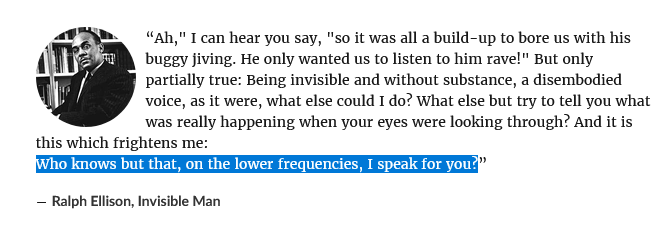
All communication is based on the sometimes vain hope that we will be understood, and the vainglorious possibility it might even be appreciated.
You just have to trust that if you tell it well enough it will find its own level. Maybe not in your lifetime, and even if so, you may not outlive your generation in other’s minds. After you’re dead, what’s it matter. As Drive-by Truckers’ Mike Cooley sings, “making money you can’t spend ain’t what being dead’s about.”
In the end, it’s really just golf. The only person you’re really competing against is yourself, and you want to be a gracious winner given the competition.