MLB Raises Bar on the Minors
MLB (compelled to) Do Right By Its Workers (Revisited)
Four years ago, thanks in large part to a $185M lawsuit, MLB finally squared itself with its employees. When we began exploring this story, we found, for the moment, it had a happy ending. While there is lingering peril in the municipal stadium blitz – it's not the first such case – for the most part, it's a story of how things can actually work out pretty well, especially given the initially sorry state. For the third biggest sport in America, the conditions in its "job training facilities" were pretty sad.
The result was minor league salaries essentially doubling (all playing staff – coaches, players, trainers – are now paid by the MLB affiliates), an in-season furnished apartment or stipend, and upgraded, on-site gym and training facilities, (Before many teams offered players local gym memberships, if you can believe it.)
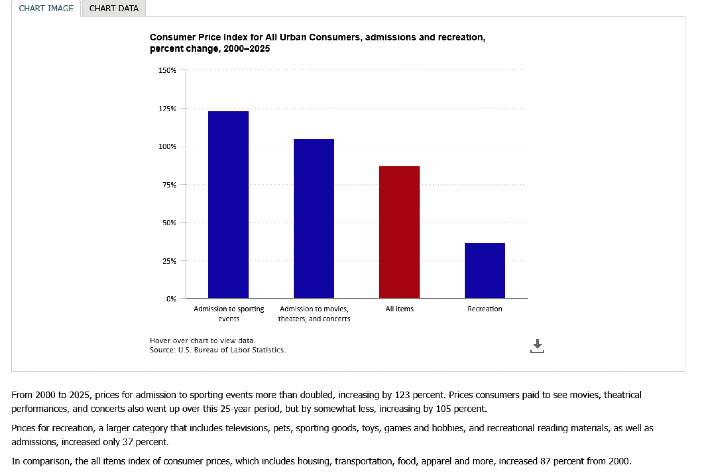
Looking back at the changes over the last five years, it’s worked out surprisingly well for all involved on most fronts, other than attendance, and that might just be the result of athletic inflation (which has grown 50% faster than consumer prices).
All of this is a result of the unionization of the minor leagues and adoption of the first minor league baseball (MiLB) Collective Bargaining Agreement which was signed in 2023 and runs through 2027.
(The perceptive among you might have noted that the minor league agreement runs for one year longer than the current major league agreement, which is up at the end of this year. With major league owners pushing for a salary cap and a lockout expected, it’s reasonable to expect that minor league baseball is, on some level, MLB’s hedge. The CBA also included a provision promising not to strike.)
As a result of the contract, salaries, which were as low as $1100 month for the six to seven month season, doubled, there’s weekly money for spring training and off-sesason camps, guaranteed pre- and post- game meals (the stories are legion about ballplayers surviving on PB&J, and the cost of complaining about it), payments for off-season workouts, year-round checks (many minor league ballplayers worked second, off-season jobs).
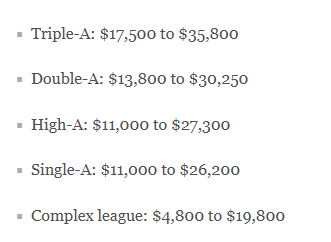
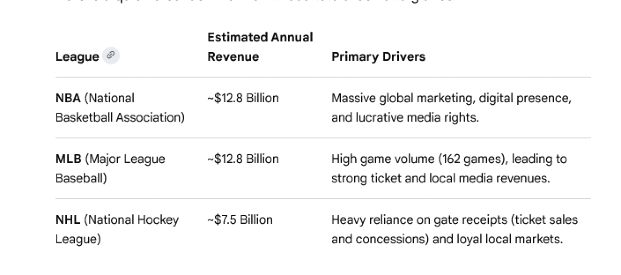
To be clear, this only brings it in line with basketball, whose G-League players make $35,000/year, while NHL minor leaguers make $47,500. It’s fair to note that there are less many minor league basketball (31) and hockey teams (89) combined than there are minor league baseball teams (around 150, 120 affiliated with MLB teams).
Of course, it wasn’t some act of kindness. The MLB lost a 2022 class-action suit over the way they treated the players, worth $185 million dollars (a third of that lawyers and litigation costs). They had argued baseball violated fair labor rules, failing to pay them overtime for their 50 to 60 hour work weeks, which included 13-hour bus rides. The suit rewarded over 20,000 players with around $5,000, and led to the unionization of the league as part of the settlement. The CBA followed a year later.
(Minor league baseball subsequently changed the schedules so teams only traveled once a week and played their opponent for six straight days with Mondays always off, drastically reducing the travel, and forcing commercial flights on any travel over 500 miles. Any travel over 250 miles must bring a second sleeper bus. Traveling once a week instead of 3-4 times every two weeks has cut travel costs by a quarter to a half depending on the league.)
The minor leagues were a novel concept formulated in the thirties by (then) St. Louis exec Branch Rickey (who later signed Jackie Robinson, integrating baseball). His club couldn't afford to pay the independent leagues for young players. (The majors would pay for promising players cultivated by the various competing independent, lesser baseball leagues.) Rickey realized it'd be cheaper to run its own teams, developing cultivate its own talent. The success of his innovation led teams to form loose agreements with other “satellite” clubs to develop talent for them and the minors were born.
Contraction But Less Chaos
The idea that first drew us to the story was related to the communities that had lost their baseball teams. When the majors formalized their control of the minor leagues in 2021, a year before the court settlement (but presumably knowing what was coming down the pipe), they trimmed the number of teams associated with each major league team to four – AAA, AA, High-A and Low-A.
The rookie leagues were reconstituted and became part of several independent leagues, some with essentially rotating college age summer play, others with much older players that the teams themselves must secure. They were also put in control of their own marketing which has proven an enormous boon. Affiliated teams control none of the players, the coaches or even the IP of the uniforms and name. These unaffiliated teams apparently have been able to really capitalize.
The Burlington Sock Puppets in Burlington, NC became a collegiate summer team showcasing rising college freshmen and sophomores, and found they could make a bunch of money in merchandise, then when they were the Burlington Royals and had no control of the branding.
“In 2015, once a week I would ship a hat out,” Burlington GM Ryan Keur said. “Within the last three years, I’d guess we’ve sold more Sock Puppets (merchandise) than we had for the past 35 years combined by significant amounts. That’s been a really nice boost.
“Merchandise was not even something we considered as a revenue driver before being able to build our own identity. There wasn’t a serious upside.”
Other places like Trenton, went from a Double A Yankees affiliate to a collegiate summer league team, yet hardly saw any drop in attendance. In the 2024 Baseball America piece, it notes they drew less people (140,000 less) but because there were less games; it proved to be 221 more per game!
“Those people who thought the whole world would end didn’t understand why people came out to our games,” Kane County Cougars owner Dr. Bob Froelich told Baseball America. The economics changed somewhat, as the team now pays the players and coaches, but they also don’t have to share revenues “It’s sort of a rounding error in terms of financial impact."
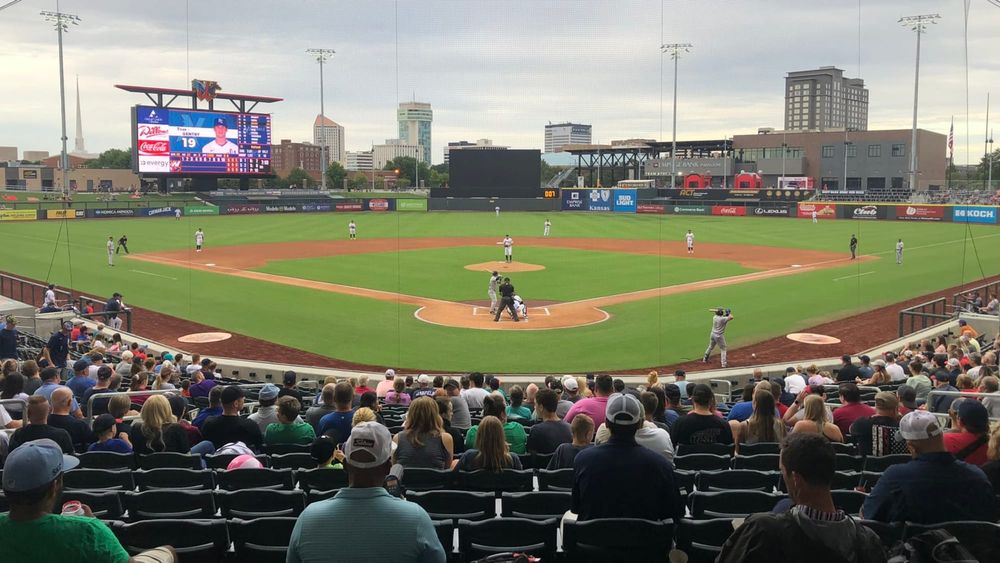
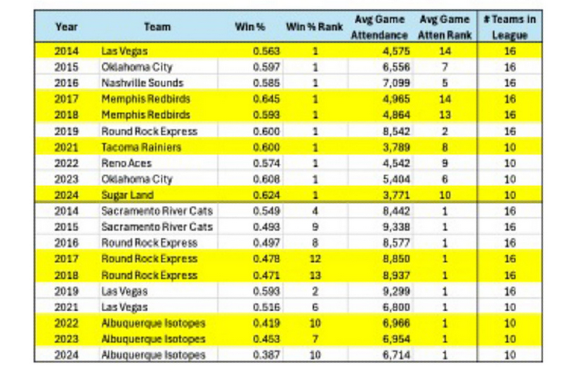
Indeed, a look at attendance in the PCL a few years ago, suggests that winning in the minor leagues isn’t important to attendance. This isn’t the majors, and team identification doesn’t operate the same, probably because the connection to the players is more tenuous – you are rooting for very local laundry. As Froelich suggests, the reasons people attend a minor league game differ significantly from the majors and is more about the environs and the vibe.
Stadium Shenanigans De Rigueur
Obviously, every community is different. In Rhode Island, the Pawtucket Triple-A team left for Worcester MA shortly before I hit town after COVID. The team abandoned a 51-year relationship for Worcester, who built a city park to attract the team at a cost of $150 million, two-thirds paid by the city. A business district around the park was expected to pay for the stadium but is so far about $2 million in the hole in the first 7 years, and a study in 2023 pegged the ultimate losses for Worcester at 40%-60% of its initial investment. (Stadiums just don't do that much for the economy, but are a nice amenity for the city, like a large park or museum,)
This is sort of the “hidden cost” in the agreement, though it’s unfortunately just the nature of the sports business these days. In order to provide professional level instruction to the players they needed professional level accommodations, creating a set of “demands” that cities needed to meet or lose their team. Again, obviously unsavory blackmail, but simply the nature of operating a finite resource in a monopoly sports environs. Pawtucket "won" by not spending $100 million to build a baseball stadium.
Instead they built a $140 million stadium for the new professional soccer team whose games I catered in 2024 at Bryant University. I’m not sure how they expect to pay that off, and so Worcester’s folly became Pawtucket’s folly. But they now have the Rhode Island FC! And they tore down the baseball stadium for a high school. So, Plus?
This is why it’s too hard to feel bad for cities that lose their teams. Their politicians are just going to rob them to fill the hole, might as well keep the team just for continuity sake if you’re gonna pay $100-$140 million for a new stadium either way.
It sucks, but our collective thirst for live athletics is holding us hostage at the hands of billionaire owners who could privately support their multi-billion dollar investments but know it’s a poor use of money, and anything’s better if someone else pays for it. It's pretty much an established fact, like the failure of trickle-down economics & the laughable Laffer curve, that for some reason has never really found purchase in the minds of those writing about these things. Wonder why.
New facility requirements included on-site weight rooms, properly sized batting cages and pitching tunnels, dining facilities, and separate locker room facilities for women, who are increasingly coaching, managing and umpiring. Renovating ballparks is expensive (~$5 million), and demolishing them isn't cheap, either (up to $1 million).
Since MLB’s 2021 decree, at least $2.3 billion has been spent or committed to stadium investment, with several big stadium projects recently completing, stealing teams and revenue from neighboring jurisdictions or farther. In Daytona Beach, Florida, the oldest park in minor league baseball, 100 year old Jackie Robinson Field, where the baseball player made his 1946 spring debut, received a $50 million public makeover.
In just the past two years, nine new minor league stadiums have opened, most funded with large public expenditures. This could be an issue, though it's obviously not as profitable to move a minor league team as a major league one.
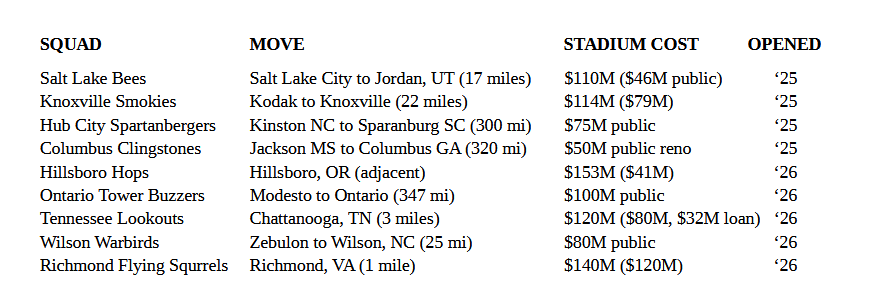
he last time such upgrades were demanded as many as 28 teams changed locales over a five year period. In general, there’s a certain amount of tumult in minor league franchises, in part because agreements were but 3-4 years, but the new settlement has been accompanied by changing franchise agreements to a standard of ten years, and many accompanying new stadiums go for 25 years.
Paying for Billionaires is What We Do
This comes at a renewed high tide for such behavior with new stadiums going up in several cities and expansion in future for baseball and basketball which are eyeing two new teams to bring them to 32.
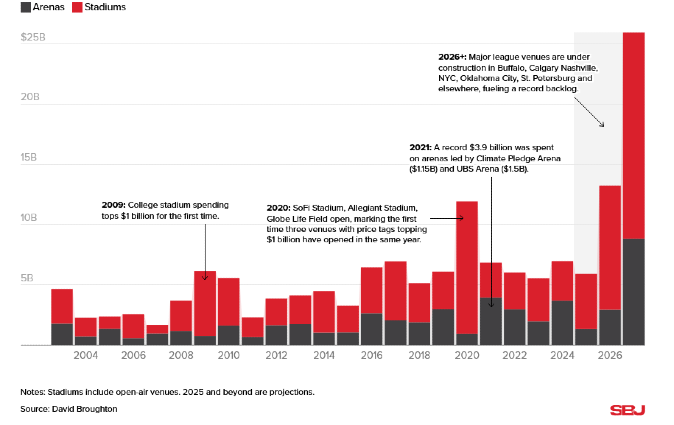
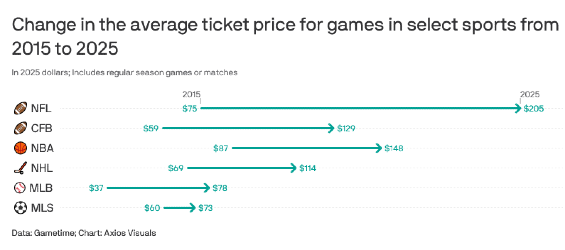
Unfortunately, someone pays for all this. Anyone who has financed trips to the ballpark in successive decades knows how this works. But it very much used to be that minor league baseball was a fun, cheap summer date, but that’s increasingly not the case. These new facilities and costs are being borne by the fans in average ticket costs. Premium seating costs are increasing even faster
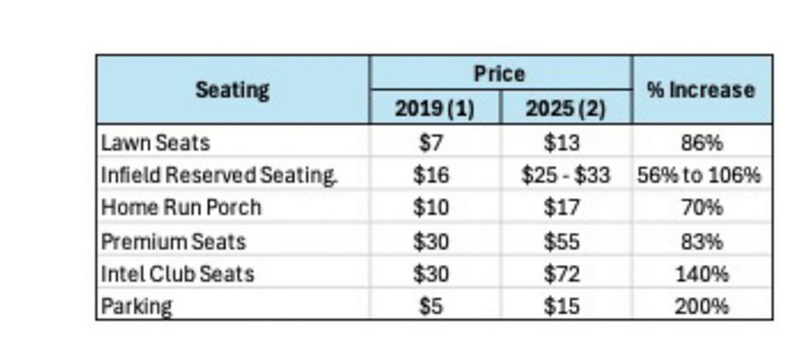
Looking just at one PCL team, the Round Rock Express, you can see the increases inspired (at least in part) by the new standards on seats. This doesn’t even take into account the rising cost of concessions. One study found that a night out at a Boston Red Sox game for the family, was the most expensive in the MLB running $366 for tickets, parking, 4 hot dogs, 2 beers, 2 soft drinks, and a hat.
Just as a side note, some sports franchises have realized they can make more money by cutting the price of concessions than they do with $8 hot dogs and $5 sodas. Concessions make up a very small part of the team’s revenue stream, particularly compared to merch, which increased by 20% when Atlanta's franchise cut hot dogs and sodas to $2.
Attendance Keeps Slumping
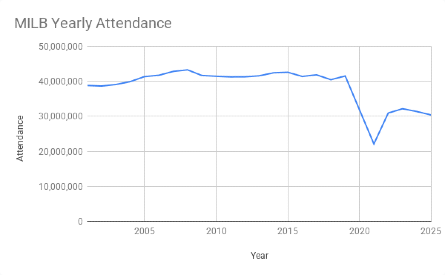
These increasing costs are undoubtedly at least partially responsible for the fall-off in minor league attendance since the pandemic. Indeed, MiLB is in the midst of a slow by sustained slump. Last year it drew 3847 fans on average, the lowest mark in 20 years. Until July 31 that pace was 3730. Only a furious last month of the season kept MiLB from a disastrous 4.5% drop and over the 30 million mark. That’s an 11% improvement the final month of the season. (So maybe a minor league pennant race does has some impact?)
That said, the costs of running a team are relatively low, with big league squad picking up all the personnel costs – typically between $10 million and $15 million a season for scouting, salaries and bonuses – leaving those that draw with fat pockets. The top 20 clubs in attendance average operating income (earnings before interest, taxes and depreciation) of $3 million.
The new stadiums will mean new suites, which diminishes the losses of falling attendance by catering to the upper half of the K-shaped economy. The Class-A Dayton Dragons which moved from Rockford, IL in 1998 has a 1600 consecutive game sell-out streak. Built for $26M in 2000, their stadium underwent $20M in renovations to meet MiLB’s new standards, with a quarter of that cost picked up by the team and 20% picked up by the county.
“Minor league teams compete with movie theaters for entertainment dollars. You charge people $8 to $10 to get in, and then sell them as much beer, hot dogs and popcorn as you can,” Randel Vataha, founder and president of Game Plan, a Boston sports banking company told Forbes in 2012. At the time, he estimated Dayton’s 30 suites raked in $2.5M in sponsorship revenue, fourth-most in the minors. “With a minor league team, you are really running a themed restaurant with a cover charge.”
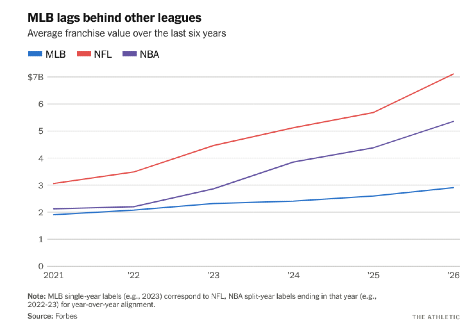
Minor league baseball team valuations have low-key exploded in recent years. The Sacramento River Cats were sold (with their 26-year old stadium) for $92M in 2022, Worcester Red Sox (and the new stadium) for $70M in 2023. Private Equity has become a big proponent and now own stakes in 53 of the 120 affiliated minor league teams, 48 of them owned by the Silver Lake, CA company Diamond Holdings. It offers a cheaper entry with a pro baseball team being worth about $2.6 billion, and being on the low-end in sports, to baseball owners’ great chagrin.
Unfortunately, these teams are a part of the civic fabric. Many have been in their communities for more than 50 years, and those people will more readily be leveraged. Eugene, OR now faces an issue after its voters rejected a funding proposal, forcing the team -which has a lease through 2027 – to look for other sites, like Medford, OR.
However, I has begun to feel like this might be the tipping point of major sports leverage. They aren’t going to win the economic debate; it’s settled that they don’t help the community, but rather draw money that would go elsewhere locally otherwise. And if they’re mainly something to do, as is the case for many people rooting for the less persuasive (see, televised) sports than baseball, basketball, football, it's appreciated as a fun thing, not out of some instinctual fandom. As the minor league attendance numbers suggest, it’s more about the experience than the winning.
One wonders as new professional sports squads emerge on a daily basis, especially women’s sports (with new pro softball, hockey, soccer, volleyball and basketball leagues popping up), if it’s reasonable to wonder how much longer the pale imitation of the major sports will continue to outdraw the growing variety of novel women sports and others, such as barnstorming leagues like Banana Baseball. Or maybe the inclusion of women in a typically male realm will eventually equalize attendance, gender wise.
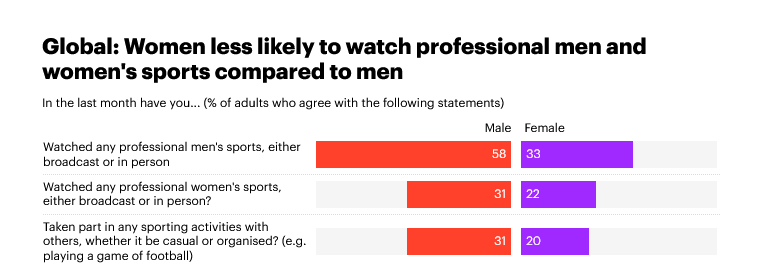
Indeed, given the explosive growth in major women sports, it's fair to wonder if we're talking about 10-15 years not 20-30.