Frack the Police
Reducing Law Enforcement’s Responsibilities After Years of Misbehavior
I don’t know what late-era Roman entertainment was like but I imagine plenty of overcooked crime/legal procedurals. There’s a well-established cultural pattern where a society undergoing demonstrative institutional decay answers with retrograde (see, mid) art focused on tradition, order and stability – the kind of things not found in society, aka wish fulfillment.
It mirrors the idea of besieged elites doubling-down rather than surrendering a modicum of privilege, which is the kind of thing that works right up until it fails miserably. Which to me is the same as saying that there were plenty of off-ramps for law enforcement to address its issues with violence, over-zealous enforcement, quotas, implicit bias and pretextual profiling before we arrived here. The Reap/Sow cycle exists because it works, so no blue tears.
They don’t change. Indeed, many don’t want to be our protectors, but see themselves as prison guards ala Milgram. (Don’t drop the soap!) A significant part of the pool teems with racism and little-man-with-a-gun-in-his-hand self-selection, and the "us vs them" orientation has a socialization effect (alongside the thin blue line). The predilection toward domineering, conservative, aggressive and misogyny is pretty well demonstrated by now.
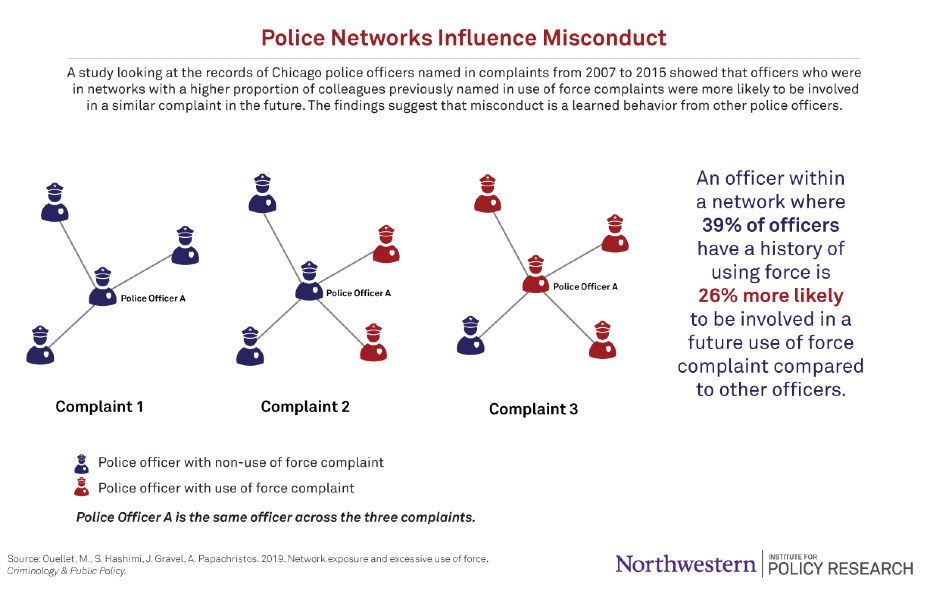
The issue is probably concentrated in a minority of officers that the rest of the force protects, betraying their commitment to the community. Perhaps if police liability insurance premiums came out of their budget their priorities would change?
Feels like I have this deep, long memory/feeling about people learning bad moral habits if they get something for free, and I’d hate for the police to develop bad habits. I think it's called moral hazard? They need some skin in the game, even if it's just no more overtime after a misconduct complaint.
Studies consistently show 5%-10% of the force commit roughly a third of all citizen complaints. Ten NYPD cops were responsible for $68 million in payouts over a dozen years. A New Jersey examination of Use-of-Force reports found 10% of the cops were responsible for 38% of the incidents. Bad apples proliferate because nobody’s minding the basket.
We don’t have to run down the names and incidents to be aware that American cops have an especially large mote in their eye about African Americans. A 2019 study found they were 2.5 more likely to be killed by cops and three times more likely to be beaten, despite being despite whites outnumbering blacks five to one.
We spend over $100 Billion on law enforcement but can’t even clear half the murders and just one in five non-fatal shootings. Studies suggest police charge about 11% of all serious crimes (many go unreported!) and get convictions just 2% of the time. Duncan Donuts only makes $1.25B annually – that’s a fuckload of donuts for the kind of ROI we’re getting!
Plus there are enormous racial disparities such that Chicago inner city homicides are solved 21% of the time, while the suburban white neighborhoods saw a 45% clearance rate. That’s racism in resources and priorities, even if some of that may be many in the urban hoods won't talk to the cops anymore, based on experience.
Maybe if they spent less time on traffic stops they could focus on making themselves useful?
A 2022 report from the ACLU using records from Los Angeles, Sacramento, San Diego and Riverside police found 88% of LA County sheriffs’ time was spent on officer initiated stops with just 11% based on a suspicion of a crime. Just 1% of all traffic stops results in seizure of contraband (drugs, weapons). Indeed, in Sacramento, four out of five of these pretextual stops ended with no more than a warning. (Don’t tell Kavanaugh!)
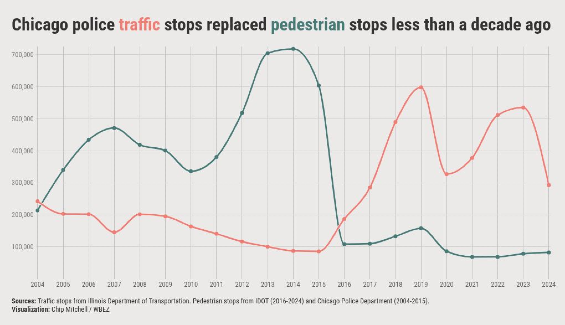
Yet this is the most likely encounter for a citizen with law enforcement and if you’re black it has a relatively high probability of going very very wrong for absolutely no reason. In 2024, police killed 152 people during routine traffic stops, more than a quarter were black.
Not-cho Cheese
An interesting historical fact – there were initially no regulations for cars, well into the 1920s, more than thirty-years after they became commercially available. For one, most police didn’t have cars!
Enforcement was left to traffic vigilantes, who followed cars and took down their plate numbers, then tried to browbeat enforcement or took the case to the magistrate themselves. There weren’t traffic lights until the late twenties, just patrolmen at intersections with a whistle.
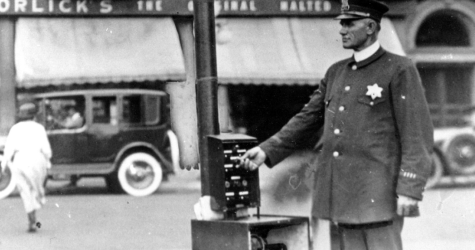
It wasn’t until the thirties that state police and traffic patrols were professionalized and cars became more heavily regulated. Before that, just frontier justice, years before the LA freeway or Lee Malvo.
Nowadays traffic stops comprise 87% of all police-initiated encounters, and more than all resident-initiated encounters about a reported crime. Yeah. In 2022 there were 16.3 million traffic stops versus 15.6 million crime report encounters.
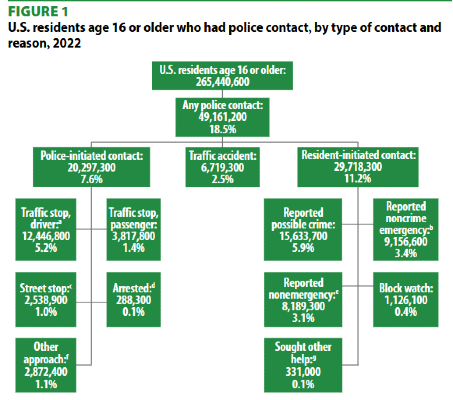
Given the rather low value of these stops – rarely leading to a bust, despite the mythic narrative – it makes a lot of sense to take this off (armed) law enforcement’s plate. Dedicated unarmed public safety teams could easily patrol traffic while reducing the most fraught daily law enforcement encounter and the one most likely to result in unnecessary death.
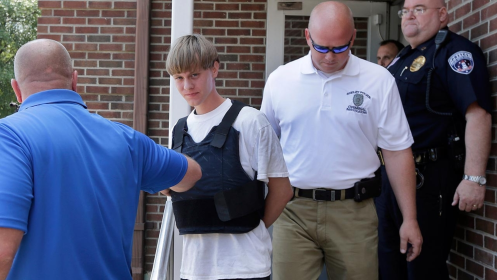
(If cops weren’t trained to freak out first, shoot next, and ask questions later, we could have a different discussion, but sadly we live in the timeline where cops take crackers mass shooters to Burger King when they kill African Americans.)
That’s one of the several leading ideas on alternatives to policing, mostly designed to trim back police mandates.
Not only are cops not good at solving crimes, statistics suggest they have minimal impact on preventing them. Indeed, California's experience is that the more cops they hire, the worse their performance.
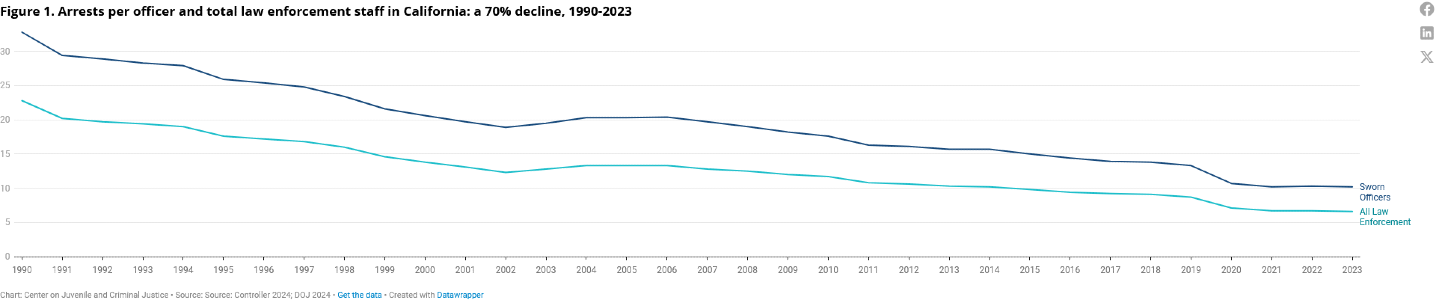
"Our 20-year analysis of California’s 51 major cities shows that increased law enforcement budgets and personnel correlate with significantly worse crime clearance rates and higher crime incidence. This trend has occurred both before the justice reform era (2003−2009) and during recent reform years (2010−2022), indicating that reforms have had little to no impact on these outcomes."
They don’t come to help or serve, but to enforce the state’s laws, often with surprisingly little respect or care for the victims. If they arrive at all. None of which encourages people to report crime.
There is a reason the police are disparaged as the watchdogs of the elite. We need more Columbos, who only respected the law. (Talk about a cultural zeitgeist.)
Giving Social/Mental Health Issues to People with Guns
There’s an old psychological truism that people are never looking for advice, so much as validation. So, when as a society we deal with deficits in our institutions and safety net by calling in order-keepers instead of problem-solvers, you’re revealing preferences.
Our political distaste for spending money on the social care on the front-end ensures that we pay a higher toll on the back-end. (This is one of several reasons why American health care is so much more expensive – less life-long preventive/ameliorative care.)
According to the Washington Post, about a quarter of all police shootings involve a person in mental distress. This has become such a prevalent reality people won’t call the cops in such circumstances.
What does that say about trust in law enforcement, and how do you square that with fact they are allegedly deployed as public service and for their safety? What are we paying for? What’s gonna repair that trust? Are they even trying?
Yet this is how the system has been structured. Given our long unwillingness to treat mental health as a real thing, and continued demonization of the struggles of a substantial number of Americans. We discourage treatment and tell people to gut-up. Is it any wonder we would send a gun to a brain disturbance?
Two models have developed for addressing 911 “mental health” calls.
In Springfield and Eugene, OR a group known as CAHOOTS (Crisis Assistance Helping Out On The Streets) will divert such calls, sending a medic and a crisis worker. (Last year due to lost funding, CAHOOTS completely cut its service in Eugene – after 36 years of operation – and trimmed its mobile intervention times to 11am – 11pm.)
Other groups are operating in Albuquerque (Albuquerque Community Safety) and Denver (Supported Team Assisted Response), while Houston had a similar program, Crisis Intervention Response Team until 2008.
The other approach, employed in Durham, NC’s Holistic Empathetic Assistance Response Teams (HEART) involves embedding crisis and medical officers in units responding to such calls, instead of sending a separate team.
These programs are more like pilot programs, diverting a small percentage of such calls (1%-5%) and are novel enough for data to be scarce. But lightening law enforcement’s load is the way, and this is a good place.
Dayton, OH has a Mediation Response Unit that sends a mediators to non-violent 911 noise and tenant/landlord dispute calls from 8am to 8pm. Other cities, such as Newark, have teams working locally in troubled neighborhoods that deal with crisis and provide social services, similar to what has been done with schools in the Harlem Chldren’s Zone, doing social outreach as preventive care.
The issue so far is that these alternative crisis teams have generally been that they're funded by non-profits, which while in partnership with the city, face their own financial issues, while working within the city relies on the same institutions that have failed at police reform for decades. That and nobody wants to spend any money on this, even as law enforcement spending climbs.
Police-Focused Solutions
If we could’ve relied on police-focused solutions we wouldn’t be here. Cameras are nice in that they can improve conviction rates on malfeasance, but you actually need law enforcement that is more interested in rooting out corruption than hiding it. In this manner it’s no different than most government agencies, but probably significantly worse on all metrics.
Putting cameras on cops doesn't help unless they're always on and the footage is publicly available. Anything less and you're just doing public relations. In real life, the footage keeps getting "lost." Or they just refuse to release it. Studies examining police killings found 58%-67% of the time they refused to release the footage. Even those caught rarely face substantive penalty, and if they do, they often relocate and find another police job.
You can embrace attempts to teach officers de-escalation, engage in role-playing and forcing officers to live in the communities they police. Good small fixes. But we are well beyond band-aids, and none of these fixes reach the hardcore incorrigibles that are doing the vast majority of the bad stuff.
Indeed, we need even more scrutiny of law enforcement in the coming years just to root out treasonous white supremacists and christian nationalists from the ranks.
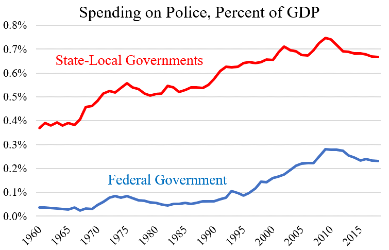
If we continue to give them more and more money without requiring anything of them, we'll just get more of the same, only more of it.
The Peace Dividend
We need to stop, and we need to do it for our own good. The money isn't doing anything but militarizing police forces which doesn't end well, if ICE is any indication. We need to reach into there and claw back their mandate, immunity and pay rates.
Let's be straight - it's one of the only places where a person without any advanced degree can readily earn enough to afford a boat. In 25 of 50 states, they are paid 150 percent or more of the median salary. Most of these guys are paying off student loans, but they're paid like people with degrees.
Just call it a reallocation of resources. But make the case! The extraordinary expenditure on law enforcement is not befitting a society where crime has been falling for fifty years, or where they regularly kill the people they're supposed to be protecting. At TRAFFIC STOPS FFS. It's worse than the Lotto!
"For the average motorist, the overall risk of being killed by police during a traffic stop is less than 1 in 1 million per stop," reports the New York Times.
Like other public servants, they need to prove their worth (as something other than a bulwark against us going French Revolution on our Tech Bros). Send DOGE into the precincts!
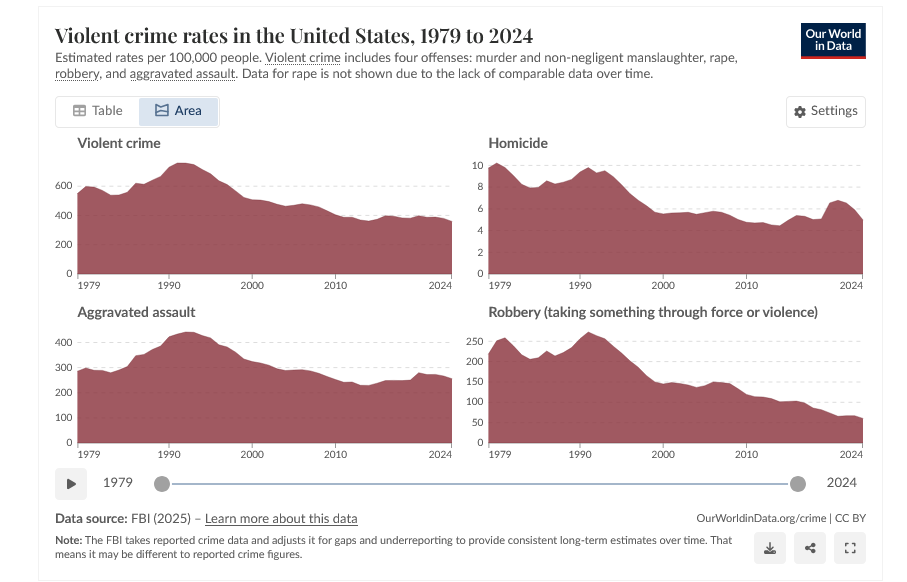
Now that we’ve won the war on crime, maybe some of y’all can go do something else. Maybe work for Erik Prince in Russia? Learn to Skydive. Maybe Free Diving. Or Free Soloing. Go Wild! Get your Adrenaline Junkie on in a way that only jeopardizes your own life!
Camden, NJ finally went so far after repeated excessive force and corruption issues as firing the entire department and making them reapply for their jobs. Excessive force complaints shrunk by 95 percent from 2014’s 65 complaint peak to three complaints in 2019. Somehow murders dropped by over 70%, and violent crime decreased by 46%. I’m not saying cops are an impediment to justice, but I don’t mind implying it.
If the police wanted us to trust instead of fear them, they’d take steps like these. But there’s less accountability demanded of those you fear than those you trust, and if you aren’t a particularly moral person, that’s a downside.
The question is whether we should fill our law enforcement with the not particularly moral and the implicitly biased when there are other options calling for less cop involvement/jurisdiction overall, and these changes would come with a significant cost savings, not just from overtime and police brutality settlements, but from less manpower hours needed thanks to much less expensive, less dangerous alternatives.
It's just a larger scale mock-up of trying to keep toxic individuals from intruding on your life. It's not really the other 85% of law enforcement you fear, but it's hard to condone letting them get away with it. Their job is upholding the law and they can't even get their colleagues to do it. What does that say?