
Dropping Science: Back Pain, Hair-Growing Combs, Vibrating Brain Pans, Chimera RNA & the Archeology of Authoritarians.
Synopsis Science
Finding Where Back Pain Originates (in our Brain!)
Vibrating Beds and Pink Noise Machines: Sleep Interventions To Clean (?) Your Brain
Like Non-Coding DNA, Chimera RNA Was Once Consider Junk, But May Drive Disease
Recent Explorations of Alzheimer's, Anesthesia & Wakefulness Suggest Consciousness May Be a Coordinated Function Orchestrated in the Brain Stem

What Archeology Tells Us About Authoritarians
Why are some societies ruled by autocrats — powerful people who make all the decisions with barely, if any, checks and balances — while in others, the governed actually have a say?

If you ask an archaeologist, historian or political scientist, this is how the story traditionally goes: People used to move around in small groups to hunt and gather, making decisions more or less collectively. Then they invented agriculture, which tied them to particular patches of land, and allowed some of them to store and hoard resources. This inevitably led to inequality in wealth and power.
This inequality grew as populations expanded and some villages became cities that were so populous they needed strong leaders to maintain order among many. And that was the state of the world until the ancient Greeks devised a new approach called “democracy.”
Democracy waned during the Middle Ages, then regained momentum centuries later, again in Europe, the story goes. From there, it slowly but steadily spread to other regions, giving autocrats a run for their money. It’s a tidy tale, but a vast oversimplification, says archaeologist Gary Feinman of the Field Museum in Chicago.
His own research shows that autocratic governments are not inevitable when populations grow larger — a variety of societies around the globe throughout history have done things differently. What’s more, these less autocratically organized societies were neither limited to, nor more common, in Europe, but found around the world, from Teotihuacan in Mexico to Mohenjo-daro in Pakistan. (REST OF STORY)

Baker's Dozen of Quick Hitters (No Synopsis)
Chronic Back Pain Triggers “Self Concept” Part of the Brain
More than four decades ago, a New York rehabilitative medicine specialist, Dr. John E. Sarno, published the first of two books arguing that back pain was a usually a mind-body problem and not due to anything biomechanic. He’d noted that most of his patients with chronic back pain didn’t have an acute injury or any structural spinal issues. He attributed the pain to suppressed stress and emotional turmoil the tension of which wound up stored in the back.
This was radical thinking in 1982. (That's when Mind Over Back Pain came out and it was followed by 1991’s Healing Back Pain: The Mind-Body Connection. We read the latter and it made a deep impression.) Over the years, the medical consensus has moved toward Sarno.

A 2016 article from Harvard Health notes that the First World seems to be home to far more neuroses – excuse us, we meant “back pain.”

That article references a 2016 study in the JAMA that showed treating back pain from a psychological perspective, with cognitive behavioral theory (CBT) worked better than medical care alone to address their suffering and this improvement was sustained.
Now a new study published in October in the British Journal of Anaesthesia, finds that the chronic pain sensations triggered by movement, when examined by suffers in an MRI lit up an area of the brain associated with self-reflection and day-dreaming. Researcher were surprised because the network normally becomes less active during acute transient pain, like banging your elbow or touching something hot. (As if it doesn’t need to be bothered with “real” pain.)
"We did not expect [the default mode network] to be involved at all," the study co-author, UCSD neuroscientist Fadel Zeidan, told Live Science. "We expected it to be deactivated to the point that we had to triple-check our work to make sure that the results were legit."
The scans triggered the pain by having the subjects raise their legs until it triggered a pain response and hold it. Yet when the researchers triggered a pain response by heating the subject’s calf, the default mode network, as it’s known, had reduced activity, reinforcing the idea that chronic back pain is driven in large part from something in the brain, not the body.
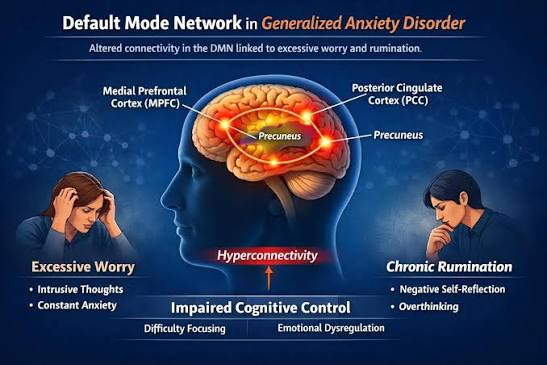
Not only that, but the participants with the most severe chronic pain had the strongest connection between the default mode network and the part of the brain the process back sensations. The study authors suggested their pain merged with how they saw themselves.
"This pain flare has almost become a part of who they are from an egocentric perspective," Zeidan said.
Zeidan's team is now investigating whether popular alternative approaches, mindfulness meditation or cognitive behavioral therapy, can influence the default mode network and help relieve chronic pain.
Could a "Brain Wash" Be Common As a Car Wash Some Day?
Researchers have shown that was we age our brain fails to as efficient of a job cleaning out the waste material in our brains. The primary “janitor” is something cerebrospinal fluid (CSF). It’s a transparent liquid surrounding brain and spinal cord to help protect/cushion against physical injury. Analyzing CSF fluid, MIT’’s Dr. Laura Lewis demonstrated its 2019 that its movement was closely tied to the slow electrical brain waves that predominate in “deep sleep.”
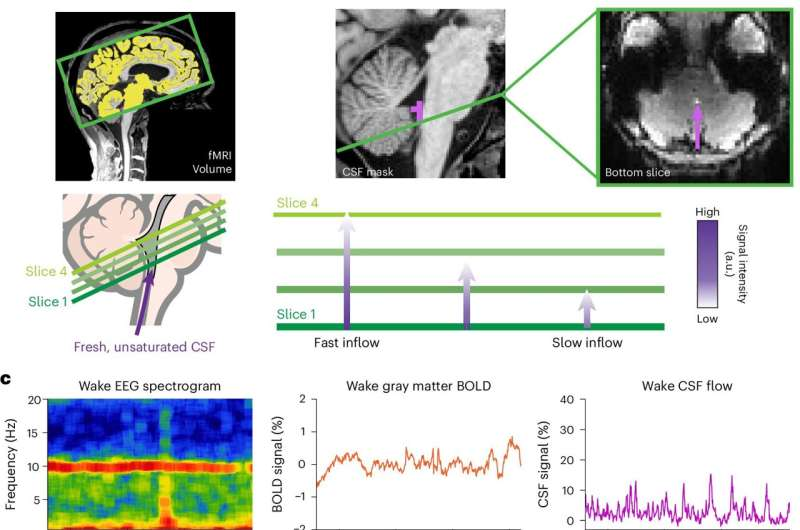
Examining MRIs she discovered the electrical waves operate with CSF to create a pump action that circulates the fluid through the brain. The waves correspond to blood vessels narrowing and widening to create the pump effect. As the amplitude of these waves can deteriorate with age, there has been a lot of study of how to augment this natural “cleaning” process.
The MIT team found they could time the building slow wave and by playing a short burst of pink noise at the wave’s highest point they were able to amplify it, strengthening CSF movement. Pink noise, like white noise, is a combination of the entire audible spectrum, but with the upper range diminished and the lower range augmented resulting in a sound, naturally enough, like a waterfall.
The effort was more of a proof of concept by Lewis, the Athinoula A. Martinos Associate Professor of Electrical Engineering and Computer Science, a member of MIT's Institute for Medical Engineering and Science and the Research Laboratory of Electronics, and an associate member of the Picower Institute for Learning and Memory, on this research, funded by Pew, McKnight and Sloan, among others. It did not explore whether this increased CSF movement enhanced sleep or showed evidence of increased debris in the blood stream.
However, it did not something interesting. Where previous studies of CSF flow had given contradictory results on the impact of aging on the flow (i.e. it generally diminishes but not consistently), found that some older adults maintained normal CSF waves despite their advanced age.
"It's really intriguing that for some of these older adults, their CSF fell right in the range of the healthy young adults," Lewis told MedicalXpress. "We are really interested in what's different in those people and how that might be related to future health outcomes."
In a similar but different study led by a team from the University of Oulu in Finland, published findings in Nature Communications on the use of literal, physical vibrations to shake the bad crap from your brain. While this has the vibe of a bad trephining experiment, it appears to have worked.
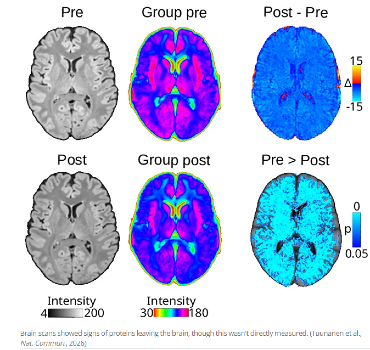
The team gave doses of a blood pressure reduction pill to participants and had them lie down on a vibrating mattress for a little over a half hour. The participants, aged from27 to 61, all showed increased levels of particular brain proteins (amyloid beta, glial fibrillary acidic protein, aka GFAP) that suggest it had an impact, no actual sleep required. The impact was greatest on the older participants and those whose blood pressure fell further. These were healthy volunteers. Further tests will look for those with early-stage memory impairments.
The Hair Growing Comb

Talk about function creating the form – we now have a comb that creates hair where there was none. Scientists have creating a unique comb-like device featuring “teeth” of different lengths that are actually electrodes and integrated drug-loading modules. The electrodes create a magnetic field that reaches beneath the skin, and the alternating lengths help generate a field more than 2.5X stronger than if they were all in a row.
Those electrical pulses help stimulate hair follicle growth while the shorter teeth are loaded with a drug delivery system that can sink the molecules deep in the skin through a process know and electroporation, which momentarily boots cell permeability.
Comparing mice with testosterone induced hair loss, untreated animals regrew 1% of their hair on shaved area of their backs in the 28-day experiment. Those who just had the electro-stim improved upon that by 40 percent, while those receiving just hair growth drugs finasteride and minoxidil experienced 50 and 70 percent regrowth, respectively.
Meanwhile those receiving electro-stim with therapeutic molecules SRD5A2 siRNA or VEGFA plasmid individually, saw 85 and 90 percent regrowth, respectively, while those that did both therapies and the electro-stim reached 98% regrowth. (VEGFA plasmid has shown promise in preclinical animal studies but lacks a large-scale human study, while SRD5A2 siRNA is a RNA-derived manner of silencing the SRD5A2 gene which suppresses the production of DHT, the hormone primarily responsible follicle shrinkage in androgenetic alopecia (male pattern baldness).
It's only a proof of concept. Now it needs to be proved safe and effective for humans.
Who You Calling Trash, Now?
One person’s junk is another person’s….. very important underlying element of our interior biosystem? Well, you learn something new everyday…. If you’re lucky.
Following in the tradition of the part of DNA that didn’t directly code proteins and thus were dismissed as junk until years later we discovered their key regulation and activation roles, a piece of RNA typically dismissed as random garbarge naturally appears to have a very important function.
Chimeric mRNA is a molecule built from different parts of DNA and fused into one, hence the name, from Chimera, which The Iliad describes having the head of a lion, the body and head of a goat protruding from its back, and a tail ending in a serpent. Typically chimeric mRNA was believer to arise from cancer-causing abnormalities where the DNA breaks and some scattered genes fuse. Occasionally mRNA sequencing would suggest chimeric mRNA in health tissues but it was usually dismissed.
A team at Harvard decided to look closer and developed a series of test that could effectively begin to screen for chimeric mRNA. The soon compiled a list of 30,000 that had been observed at least once in mammalian cells.
"There are suddenly many new possibilities for the kind of molecules and proteins that cells can create," said Harry Kane, co-first author and HMS and Gene Lay Institute research fellow in immunology in the Jackson Lab. "If it is possible to leverage chimeric RNAs for drug discovery and medicine, then this is very exciting."
Another researcher a the UVA School of Medicine, Dr. Hui Li, has tracked over 50,000 chimeric mRNAs across more than 1000 cancer cell lines. Her team found that switching off some mRNAs stopped cancer growth or killed cells. The results with breast cancer was particularly promising. They’ve also found productive targets in colon, brain and prostate cancers.
Li says this suggests that cancers use mRNAs to grow regardless of DNA mutations, leading her to believe researchers might be able to utilize mRNAs to detect cancer early.
They’re almost like fuels of the car. If you take them off, their car will stop or they will die,” Lie told a local news broadcast. “we’re at the early stage of a target identification where we do find a lot of maybe important targets in the cancer,”
The results the paper says, "demonstrate that chimeric RNAs constitute a previously underappreciated layer of gene expression, expanding the functional genome beyond conventional genetics.”