Bearing False Witness
Reviews Have Gone From Helpful to Info Warfare
There are a half dozen or so Simpsons lines that are so brilliant I feel gyped that I don’t know who is responsible. Like a latter day Yogi Berra, they speak of the human condition, like when Homer realizes, “I’m someone else.” or this classic where a disillusioned Jimbo considers law school.
"I don't believe in nothing no more. I'm going to law school."
But my favorite is, “Liquor, the cause and solution to all of man’s problems.” Over the past thirty years, the internet has pwned that joke.
The net promised so much, but whatever change we received was just a loss leader to get us into the store. Once they made us willing to pay for the convenience they offered, everything else died, allowing them to charge what they liked.
Those old enough might remember this was how chain stores crushed the idiosyncractic flavor of American towns as culture nationalized in the eighties. (Having destroyed competition, retailers are pulling back to the suburbs, leaving urban retail deserts in their wake. Dollar General is a similar rural dynamic.)
Before smartphones it was geography that ruled. You could/would only travel so far to shop. Now there are only so many local chain stores (see also, mark-up), and your online options are increasingly controlled by a few companies. What I’m describing is related to how monopolies have operated for years. The pressure point has simply changed.
Late-Stage Capitalism: Less Better Mousetrap, More Two Brands of Mousetrap
Capitalism encourages a rapacity that would be disgusting in a human being, so better to be attributed to an LLC, which a moral grey area exists apparently. (Viola, the CEO as Wizard of Oz.)
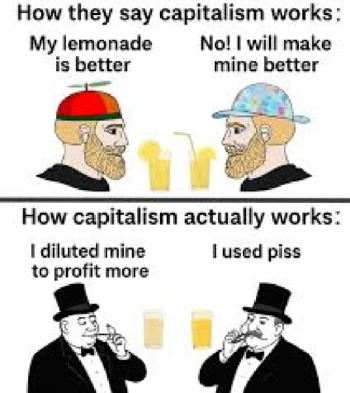
In many fields regional monopolies limit employment opportunities. Online entities have tried to replicate this extraction philosophy by creating gated gardens that people are loathe to leave, from communications protocols to social media to streaming networks.
These marketplaces can really be platforms offering anything. The key facet is that for reasons of reputation (see, Apple’s early capture of graphic creatives), content (notoriously walled world of streamers) and network effects (i.e. the idea that the size of a platform can almost force you do adopt it), people feel trapped there.
For a long-time this kind of “stickiness” was reserved for products that were of known high quality, because we had gatekeepers whose entire value was in their curation, making them reputationally responsible for what was sold. This reputational aspect is the underlying unspoken compact of society – the Karen compact, if you will: Don’t Fuck with Me, Or I’ll be back.
But as we did away with this relationship with the customer, and reputational cost became something a corporation could arbitrage away across a large population by expanding quickly. Or maybe changing their name? You shouldn’t dead name people, but corporations that try to escape accountability for decades of bad service, slipping off to become Xfinity. Yeah we still see you Comcast.
(If you’re old you might know Verizon is just another shitty AT&T clone from the Bell Labs monopoly. I Heart Radio is trying to escape the monumental shit sluice the was Clear Channel Communications, which also gave us Live Nation which formed with Ticketmaster.)
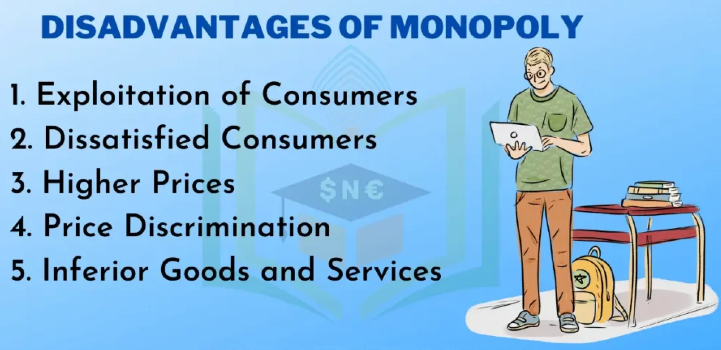
Anyway, the point is that as corporations replaced retailers that were closer to the ground, who actually really listened to the customer, we got giant corporations that only seem to understand mass consumer actions, and even that, not particularly well, Target. Talk about showing your whole ass to one of your largest clienteles and not even walking it back. Nobody in most large corporations act like their size protects them from listening to the consumer, or that’s the recent history anyway.
The Chicago School probably bears a lot of the blame in that the argued the corporations should only answer to shareholders, not stakeholders (aka the Friedman Doctrine). Prior to that corporations were understood to have a social responsibility to the community, not be carpetbagging truffle hunters. And when they say shareholders, they mean the hand-selected Board of Directors. I remember complaints about interlocking boards of directorates back in the eighties. Blackstone & Apollo, two of the biggest private equity firms were under investigation for this under Biden, in fact.
This same project has continued to spread, though the tech world is even more balkanized than Coke/Pepsi. By comparison modern media platforms are rug deals in dark alleys with a lookout around the corner.
By and large tech’s incentive as through-put (volume, volume, volume, replacing location, because “Global”) middle man is to play both sides against the middle and extract from both. With little choice but to stay on the platform, users prone to enduring greater and greater austerity/bad treatment without leaving, while the platform mostly shorts both ends. This is the basic premise of Cory Doctorow’s Theory of Enshitification. The basic idea that if you make the product enough of a monopoly, you can cut service to both sides and extract even greater profit.
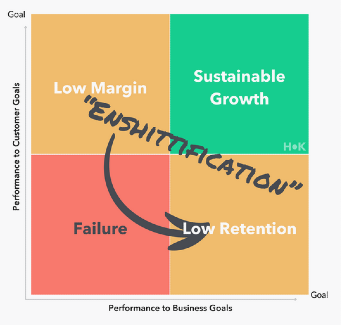
It’s fascinating stuff that I wouldn’t mind digging into deeper at some point. Like Online Dating, which I have written about (perhaps it hasn’t run yet?), there is an aspect where platforms have externalized the responsibility for the quality of the platform to the participants, even as they use all kinds of tools to manipulate the environs, leaving them no incentive to improve the product. Whereas selling stuff used to be customer-focused, malfunctioning, rigged or un-level markets have changed the dynamic by making themselves too essential to leave no matter how bad they get (e.g. MS Windows for PCs).
(This is why I use Bluesky, I don’t have an interest in an algorithm because I don’t trust what someone steers into my eyeballs. I prefer my own playlists to letting the music algorithm go wild, though at least it has a dozen years of data.)
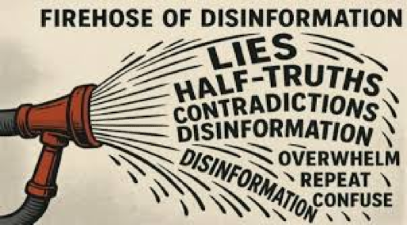
The other 21st century way of rigging the market is to pollute the information stream so badly, nobody can tell a solid product from the shitty ones. Our politics mostly work like this.
Rot Travels
Of all the things the internet brought us, the crowd-sourced reviews were one of my favorite. For a long-time it was difficult to find someone to work on your car, bake you a cake, do your teeth, etc. Every service was a complete blind date. If you didn’t trust the people with enough money to advertise widely (their margins are clearly way to large), what could you do? If you hadn’t lived in town for years, you had no word-of-mouth upon which to draw.
Hiring people and finding fresh places to eat was almost a coin flip – way too much error-per-trial, like frozen custard flavors. Reviews offered relief. And then those got fucked like everything else. It’s literally a war on authenticity and trust, where they people you can’t trust realize just being themselves, at volume creates an environment where they can thrive.
They’re destroying our informational ecosystem so their shitty scam-quality is indistinguishable from the good stuff. Just as they came for phone calls, emails and texts, they’ve come for our crowdsourced review platforms. But they’re throughput, and platforms don’t think they’re responsible. They’re not curators, they’re just a pipe. It’s “Caveat Emptor, player.” Or back to square one.
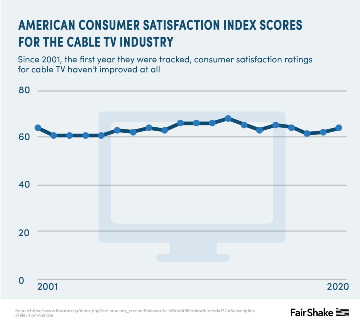
Like most of the other issues with the internet, the platforms don’t have enough skin in the game. They may offer some enticement to get you in the door, but once there, they could give a fuck. Anybody who spent several hours trying to reach their cable representative remembers the pose.
Fake reviews are not a new problem, it’s more like payola, something that never truly went away. There are stories going back a decade about the corruption of online reviews. People who give freebies or discounts for good reviews, solicit friends, ask for only 5-star reviews to respond, etc. In time gaming reviews became online grind-work. Cryptocurrency accelerated things by offering off-the-grid payment options.
For a while it remained low-grade task-monkey activity. Sign up and you’d get sent a product you could keep, and get $5-$10 for a product review, or as much as $50 for a Yelp review that sticks. Companies and eventually review farms created a race-to-the-bottom since this was something that a third-world country could do at scale for pennies on the dollar. It’s spread from Russia and Eastern Bloc countries into Southeast Asia, making enforcement all but impossible.
“The principal challenge is that much of this review brokering activity is being generated outside of the United States,” Richard Cleland, assistant director of the FTC’s division of advertising practices. “Many of the targets that we’ve identified are either located somewhere in Europe or Asia. And those are difficult for us to address.”
Meanwhile like in any rapidly corrupting system, legitimate businesses feel compelled to take part because so many competitors are.
According to a study by the consumer group, Which?, as many as one in seven Trip Advisor reviews is fraudulent and several top hotels in the top ten tourist cities had fake reviews. Their own numbers are lower (8%) but with 31 million reviews that’s still 2.5 million fakes.
Buying fake reviews is like a sugar high for a business, real but brief. It boosts sales for a minute, as the fake reviews are rooted out, and then the rating falls again, perhaps further due to higher expectations (and, typically, lower quality). But that boost of sales subsidizes further use, in a self-reinforcing corrupt feedback loop.
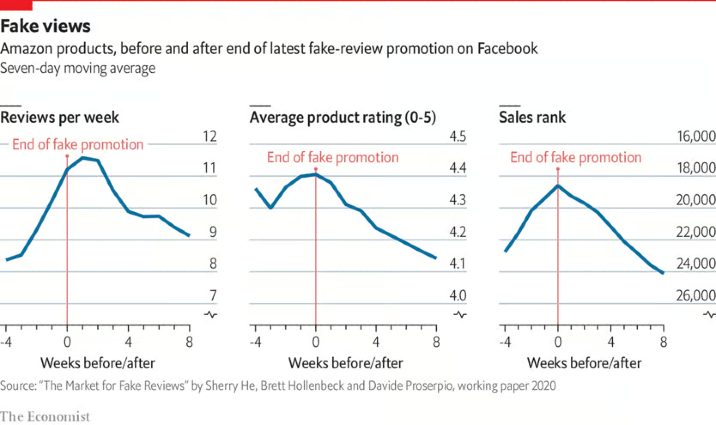
The simple fact is that marketing works, whether (??) or not it’s dishonest. In a 2011 enforcement action against Legacy Learning Systems, it was found they paid affiliates to post on blogs and bulletin boards as ordinary consumers with glowing reviews of their “Learn & Master Guitar” DVDs. Their expenditure of $250,000 helped produce $5 million in sales. (The fine settlement was $250,000. Do your own math.)
A study by Harvard back in 2016 found that an extra star on a Yelp rating can mean 5%-9% higher revenues. A 2019 analysis by The Hustle suggested that untrustworthy reviews can boost ratings by from half to a whole star in the most fraud-laden categories, such as clothes, shoes, jewelry, electronics (esp. headphones), home fitness, kitchen and weight-loss products.
It’s estimated more than a third of all online reviews are fake, and they’re growing 12% faster than legitimate reviews, with an overall cost last year of $787 Billion.
Most Services Are Local
While retail products and restaurants are obvious targets, the even more insidious enabler are local service providers, where there are generally far less reviews, and potentially less arbitrage than in an online marketplace. How many people are as rigorous looking for a dentist as they are buying candles on Amazon? That’s precisely what makes the market ripe.
Curtis Boyd, a data scientist who heads the Transparency Company, which works to clean up fake reviews says “Almost every industry is affected by it – Doctors, lawyers, preschools, everything.” He suggests the incentives are too great and the risk too negligible for many to resist.
“The fraud extends across every profession you can imagine,” Former government fraud investigator Katy Dean agreed. “I’ve seen surgeons, psychiatrists, weddings, DJ’s, lactation consultants, piano teachers, you name it.”
It’s what economists call an externality: The people causing the harm don’t bear its costs, so they have no economic incentive to stop. This has become a common issue along almost every avenue of communication of late – a steady degradation of signal to noise, from spam phone calls, email and texts to catfishing, deep fake video, phishing and fake reviews. Our entire system of mutual trust and accountability is breaking down beneath the sheer weight of constant fraud.
One doesn’t even answer unknown phone calls anymore; there’s no point. Is that where online reviews are going?
According to the FTC’s Cleland, these local spaces may be the hardest to enforce, because you don’t need (or even want) an international review farm, and it’s aside hustle anybody could manage. “You don’t need anything but a computer and a coffee shop.”
Recently a new threat has popped up of this local variety – people leaving bad reviews as an extortion technique. After a spate of 1-star reviews the business is offered a way to pay for their removal, rather than have to rely on asking the platform to remove them.
Imagine, there’s a business built on how bad platforms are at removing fraudulent reviews! It’s so rife on Google, they added a new form to handle the increase in complaints and allegedly expedite what was a slow, confusing process.
Who Will Stop the Reign?
The examples of our phone and email networks seem to be that nobody will. The entire history of the internet is their lack of moderation (too expensive!) and incentive to keep fraudsters out. Beyond even the contemporary example of internet companies actively moating and subsequently enshittifying their product doesn’t speak to their commitment to upkeep. Nor does recent corporate ethics point to a way out. Corporations were created to avoid accountability and they’ve only gotten better at it with time.
Beyond this, the emergence of cheap AI to create text content to effectively disguise both profiles and reduce the similarity of one review to the other are going to make it nearly impossible for a normal reader to know the difference between a fake and real review.
It’s now necessary to review the timing of reviews, the originating locale, and how it matches up with other reviews and reviewer activity, something requiring platform access to effectively monitor. But like with cyber-security, there is a long-standing inertia in the tech world toward risk-prevention and proactive security. It’s hard not to feel, especially given the shit-scape of our phone and email, that retailers won’t spend a dime until people begin to flee for… ???
The absence of an un-enshittified alternative and the growing disillusionment (eh, what’s the point, it’s all the same, etc.) remaining free-floating and widely dispersed creates little incentive for change. Platforms will say they are cleaning up fake reviews, but absent some outside force compelling them, one only imagines a steadily steepening downward slope.
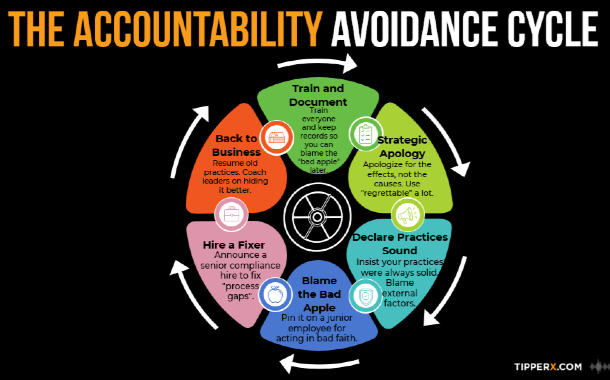
Why would this be any different? We need a culture that values accountability, and probably will require gatekeepers from outside the platforms such that their allegiances and incentives aren’t easily hacked. But at a moment when everything our leader says are lies, might not be best time to place a high value on virtue. Not with these broadcasters.
Yet our very culture is built on trust that some participants aren’t enthusiastic enough to enforce. All you can do is hope people remember and blame the proper parties.