Green on Red's Gas Food Lodging
Background
We came late to Green on Red only discovering them in the process of researching our (still in edits) Roots Rebels book, but we were immediately deep affected by this album. It’s not long, just over thirty minutes but it’s a terrific “road” album, which is to say it feels a bit rootless but on its way somewhere. It’s very much about a place, a destination, or maybe an imagined place, accessible by the road, the American dream, as witnessed from a windshield.
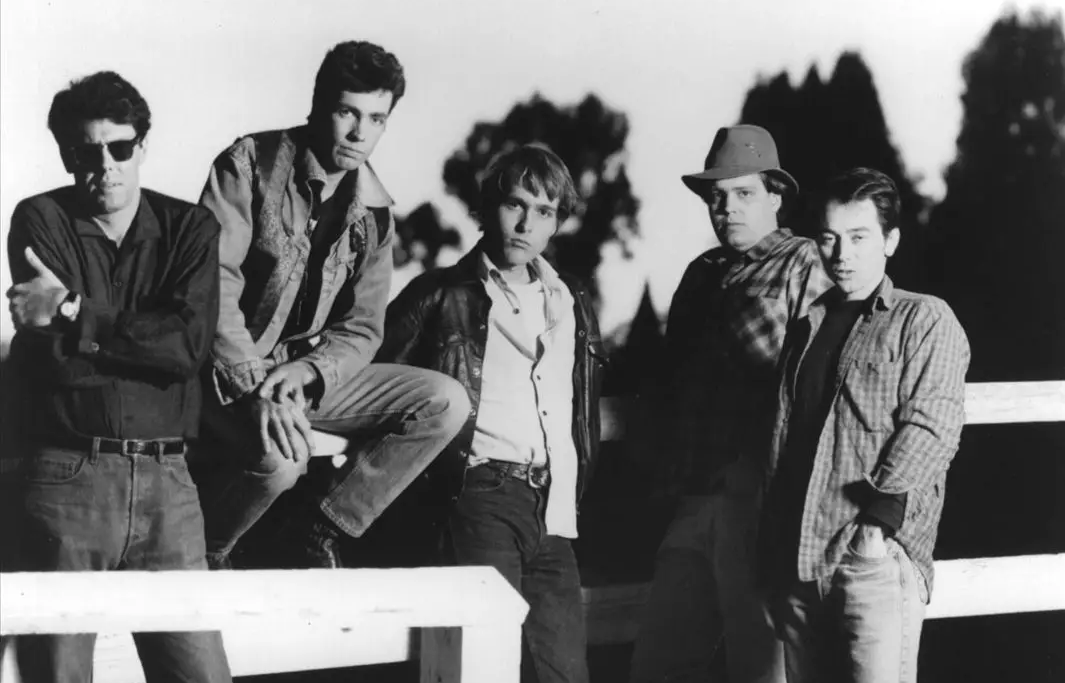
This was the first album by Green on Red to feature second guitarist Chuck Prophet, but that band had already released two albums and was on some level, quite established. (Stuart is better as an rhythm player, but keyboardist Chris Cavacas gave the music plenty of vibe.) They had a label-paid gas card, which to Prophet sounded like “making it.”
“That just seemed like the top of the mountain,” Prophet told us. He actually joined them on tour before they went in to record the album
“A lot of what became the gas food lodging record was just songs that were in the set, you know. So, it really, it really did fall together more than probably more than any other record I can remember,” said Prophet. “The producer of that record was Paul P. Cutler, a wonderful guy who I think was a friend of the band’s pot dealer or something. He played in a gothic band called ,45 Grave.”
(Cutler's had a long and interesting career, has played with Dream Syndicate and did a project with Brad Laner (Savage Republic, Medicine). This article does a nice job of talking about Cutler's long career and 2023 new album.)
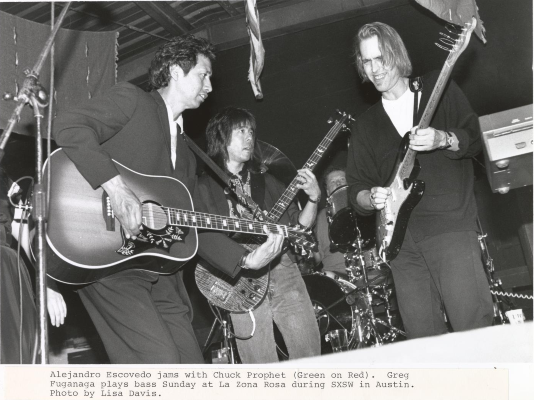
Prophet’s addition seemed to have seriously deepened the album. He made them think more about what they were doing, which cut against the grain a bit. This resulted in much richer arrangements in terms of little touches, making them rather dense despite their short length.
“Jack [Waterson, bassist] would say, if you think too much about it, it's stupid. But Chuck would come back with ‘Actually, it's kind of stupid not to think about it,’” Stuart said. “And, you know, and they were both Right.”
Prophet who grew up in Orange County (“the kind of place where if you took a tree, and five guitar players would fall out.,” he cracked) and brought greater structure to the band.
“Chuck always talks about the middle eight, on hair of the dog. Right,” Stuart recalled. “It's like, he tells us, ‘Can we put a bridge in?’ And we just look at him? We go, ‘Okay, what do you know?’ And then we just do it. We just do a standard blues bridge. Right? Just completely standard. Why not?
“I say to this day, that if we would have cut everything a half step flat, that would have took the edge off my vocal, and we would have sold twice as many records,” he adds. “But I didn't I didn't learn to do that till later. You know, I didn't learn to do that until much later.”
Though I didn’t get to talk to him, we always felt that Waterson had an all-time great observation when he noted about the band, that ‘the more money they began to make, the more it felt like a job and the less fun it became.’ I don’t have the direct quote handy, but that’s the gist. (It's very much an issue with most prepaid creative enterprise for the last half-century. We miss the Medicis.)
Of course, that may be colored by the fact that – in an absurd drug-induced/financial panic when the label that paid for an album with Dickinson, Prophet and Stuart went bankrupt leaving them with a steep bill – Stuart agreed to put the band’s name on an album his bandmates (outside Prophet) didn’t play on, to get another label to pay for the sessions the prior label’s dissolution had left them on the hook for.
It caused Stuart a lot of stress and heartache – as it should’ve – but his bandmates finally forgave him, so that’s enough for me. People do stupid things sometimes and it requires a reservoir of forgiveness if someone hasn’t already drained it. (Ironically the album was called, Here Come the Snakes, and is actually pretty damn good, the shame of it all.)
Though at the time we missed it, the album was very well received. New York Times critic/musician Robert Palmer called it “perhaps the most distinctive and accomplished of all the recent 60's-rooted albums” and it was indeed, with Rank & File’s 1982 debut Sundown, The Meat Puppets 1984 disc Meat Puppets II and The Gun Club’s 1982 disc Miami, the kind of culmination of a vibe.
The Album
The album kicks off with arguably the best song they’ve written. Stuart always was kind of a Lou Reed-esque, rambling, epic, emotional big picture guy, and this album really hits that target square. He spoke about how the rigor Prophet brought to the music encouraged him to apply the same aesthetic to the lyrics, really agonizing over the best word rather than letting himself off the hook.
The opening line sets the tone for the entire album, which is good work if you can accomplish it.
It seems that no one has any faith anymore
Well isn't that what we invented heroes for?
Then a moment later another killer couplet, that really hits home now, living in Minnesota, knowing we are going to fending off fascists for the rest of the decade.
Staring in the eyes of the preacher
Who sold me down the river
Well I got too much faith for him to deliver
Guess I'll just be poor for the rest of my life
It's better than giving up the fight
And then right into the simple chorus, “That’s What Dreams Are For.” We’re talking about the basic precepts of human decency, and how believing in them is the only thing that makes them real. The idea that failing to accept these excuses is not dreaming, but making sure the dream can become real.
It seems the handshake means nothing today
Lifetime of work sold down the river
It used to be that relationships meant something. But to rootless folks who see the world as NPC-characters to serve them, their thought and dreams are meritless. We are still trying to change that reality. And that’s totally why we invented heroes, to remind ourselves it’s a possible reality, not comic book melodrama.
The highway always lies ahead, like that American Dream, just no escaping it. “Black River” presents Stuart in his natural dissolute state of essentially, if this is Tuesday, this must be Tulsa. Like a lost stranger, he wonders if the local food will destroy his alcohol-addled digestion. “Dude, ordering chili and adding Tabasco, you are courting the disaster you fear,” which is precisely how the freewheeling Stuart rolls. In that sense, “Black River,” is that other side of the face of this album, the ramshackle drifter whose intentions and state of mind are of questionable stability. Everyone’s a stranger on the road.
Prophets’ little guitar curliques on this songs are dynamite and after the first verse keyboard player Chris Cavacas (now with old neighbor Steve Wynn’s reformed Dream Syndicate for records) delivers this great, woozy, C&W flavor organ break rich in ambiance.
It closes with this idea of the endless unending nature of the road, so open and free, yet equally capable of swallowing you whole.
Old black river, Just goes on and on
I ain't quite sure where I been
Or what I've done
That certainly feels like the segue for “Hair of the Dog” thematically. The fevered energy and spiky vocals are suggestive of the emotional state Stuart describes. Cavacas’ barrelhouse blues roll feeds the anxiety, like something nagging awaits but it’s only 10am! Next thing you know Stuart sounds sweaty singing about drinking Straubs in a place called Del Fuego. Yeah, he’s got the “Hair of the Dog.” The middle eight gives Prophet a moment to show off on guitar and the song’s over in 2:30, though it feels like a lot already happened. It’s a terrific first ten minutes.

Not the biggest fan of “This I Know” which reminds us a lot fellow Lou Reed-admirer Peter Laughner of Rocket from the Tombs (“Amphetamine”?), which later birthed the Dead Boys and Pere Ubu. It’s kind of an anthemic upbeat tune with an old-time rock rush but it’s a miss for us.
The next tune, “Fadin’ Away” isn’t their best but boy does the sound recall the Alt-Country rock vibe of a decade later. Jagged guitars steeped in reverb. It’s something of a loose vamp that attempts that sort of hypnotic hazy sun-baked road vibe of The Gun Club’s Miami.
“Easy Way Out” again brings that dust-blown troubadour coat that fits him best and there some really great guitar on this bluesy-folk track. It does have this playful chorus, “the noose gets tighter and tigher, still I can shout!” though the idea that he can plead but nobody hears it echoes the dark, senselessness of this world he’s been painting.
“Sixteen Ways” about guns taking lives in a case of mistaken identity (as per the Stones’ unsung classic, “Heartbreaker”), which has the nice choral line, “They shot my babies but / They killed my faith.“
The music of “The Drifter” is again exquisite, this beautiful line ringing with distortion and reverb like a sauced-up swagger to the bar. But it’s about a nomadic serial killer, who hunts his quarry at the bars. It was probably a much darker more palpable song when we had steeped in this stuff for decades on end from Clarice and Dexter on down. Still a beautiful haunting song which this really keenly textured guitar line. Again, only 2:30 long but it feels like it’s much more expansive, in part because of the dynamism of Prophet’s playing
Allegedly from Grey Whistle Test
On some level, “The Sea of Cortez” is the proper ending of the album. It’s interesting that the three longest songs are first, fifth and ninth, and it’s definitely part of the sequencing’s fine balance and flow. The song has this tidal ebb and flow, swelling and receding behind a killer choral couplet.
It takes money to make money they say
Ain’t it funny how love doesn’t work that way
More than any other song on the album the guitars and keyboards crash against each other in an epic tug of war. Crashing, tumultuous bleats of distortion submerge and rise above the long-sustained organ peals. Both swirl around Stuarts lazy ambling vocal strut.
It ends with a deep thought on the path of surrender or rebellion and how a long fight may not win you any of the things you fought for. Stuart sings, “Pancho Villa went back to his ranch,” noting his negotiated amnesty and retirement (for at least three years before he was assassinated), versus Emiliano Zapata, who was ambushed and killed by the government. “Zapata never got a second chance.”
It’s a rather chilling meditation on how there may not be any end to the fight you picked, and certainly not one you choose. It certainly fits with the money uber alles spirit of the chorus, and well, you know, everything around us.
Give Stuart and company credit. As evil and dispiriting as they leave us, with the fight undoing its leading resisters, a road of senseless violence, indifference and (socio-) pathology that swallows you whole after luring you onto its long black, yellow-lined tongue.
They end it with the gospel standard, “We Shall Overcome.” The fight and the spirit are as eternal as the road. They’re a Hegelian dialectic that won’t resolve until we undue the nature and influence of money.
Yeah. It’s a very very very long game we’re a part of.