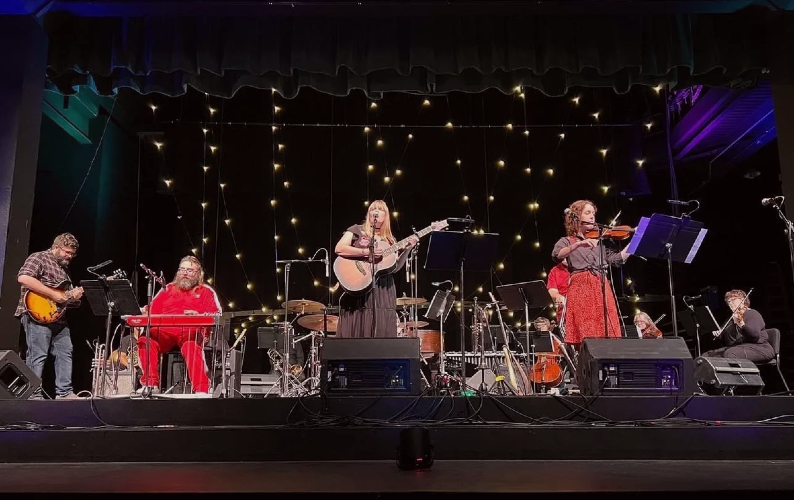
Get Comfortable with Breanne Marie & The Front Porch Sinners
The lively Duluth roots-rock/Americana sextet celebrates it's superior fourth album, Twin Trees
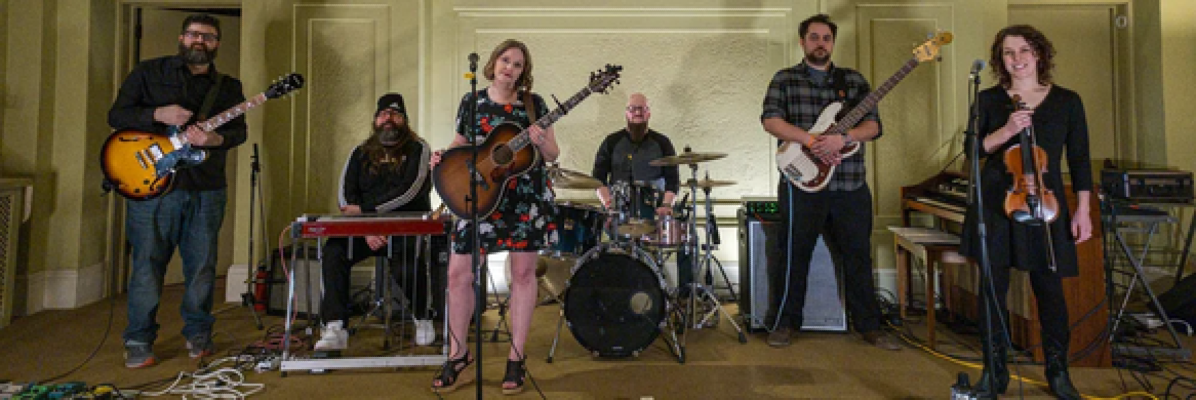
Breanne Marie &The Front Porch Sinners host their album release party & first Twin Cities show in 3(!!) years, Saturday, September 19 (7:30) at Hook and Ladder.
Breanne Marie comes across a bit like Sheri Fisher, the Midwestern nursing student and focal point of the David Foster Wallace story, “Good People,” we wrote about yesterday. (“[She] always smelled very good and clean, like someone you could trust and care about even if you weren’t in love. Lane Dean had liked the smell of her right away. His mother called her down to earth and liked her, thought she was good people.”)
The Duluth native has a warm, easy manner and her band, “the front-porch sinners” were conceived as that crew of cohorts and abettors that might plot and/or reminisce youthful indiscretions from the shared sanctuary of the front porch. That’s the vibe she and her roots rock/Americana band are intent on manifesting.
“All sinners are welcome,” laughs Marie. "When I was a kid with my brothers, we would hang out on duplex porches in the Central Hillside neighborhood of Duluth. Those were the front porches where so many awesome memories were made. We were just playing around. It was so joyful. So I love a show when people come and it feels like we're all friends hanging out on a porch.”
That community became synonymous with making music when she took up guitar as a hobby, partly out of therapy, leading inexorably to her first album, Six Strings of Peace and Sanity. The band followed when she realized that she could not only enlist her friends, but that it multiplied the joy.
“People will say, ‘Brianne, you have a really big band.’ They say it in that tone, as if I were trying to compensate for people's talents by having extra soloists. Maybe that's the way I perceive it. But when they say, ‘You have a really big band,’ I say, "Yeah, we have a lot of fun."
New & Improved
That fun also produced four discs between 2014 and 2021 – Timothy John, Wildflowers & Tumbleweeds, Salt in the Snow, and their previous disc, Juniper. While each release has demonstrated sharpening craft and greater ambition, it doesn’t quite prepare you for the leap forward of their latest release, Two Trees. It took four years – half as long as it took to release her first five releases – and you can hear it both in the richer, layered arrangements and increasingly sophisticated storytelling.
Marie had been a lurker in Singer/Songwriter Songwriting Challenge, an online songwriting group for a w-h-i-l-e. But once she dipped her toe, she didn’t Goldilocks the decision – she jumped straight in.
“Once I did, I was absolutely hooked,” she laughs. “You have to write quickly and post quickly, you know? Writing a song and knowing that you have to post it in less than a week is enough to light a fire under you to not second-guess what your process is, or what you're writing about.
“I started writing about things that I just made up. I was making up stories. I imagined people's lives, and then I started to tie those lives together with the trilogy inside the album,” Marie continues. “There's three songs that blend together leading up to the title track, about a family of three generations going through a lot of trauma and with women as the main characters. That all came out of songs that I had to write quickly about something I didn't really know.
“Then after I finished them, I went, ‘Oh my gosh, I'm actually in these songs,” Marie chuckles. “It wasn't the initial intent, it's just I identified with them. So it's a way to take myself out of songwriting, my own personal experiences.”
On some level, that’s even why she started playing guitar in the first place, as a way to manage personal experiences. Her father had been learning to play guitar with a classic Mel Bay VHS instructional video before he took his own life. Shaken by the trauma, Marie took up guitar herself as a way to process the grief. She couldn’t have known how much she’d use it.
“I decided a year after his death, I was gonna learn how to play. It 100% healed me. The act of holding a guitar is like a hug,” says Marie. “The vibrations of the music were healing me from the inside out. Then three years later, my brother died in a car accident. Then nine years later, my other brother died in an ATV accident.”
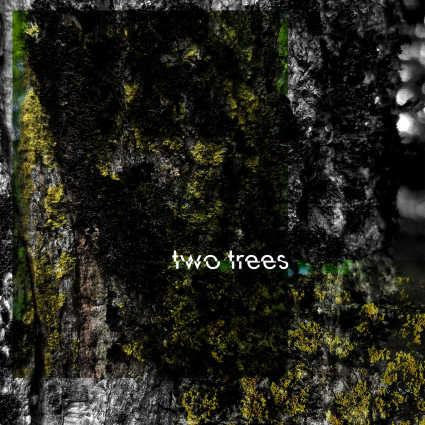
Indeed, the very title of the new album goes back to this formative experience and the way we persevere with (or sadly not, in some cases, for the lack of) the help of family and friends aka, ‘the family we make along the way.’ That’s the symbolism of the Two Trees, inspired by the view from her backyard.
“One of these trees is living, that's me, and the other tree, um, is dead and gone, and that's the grief and loss,” she explains. “They are holding each other up. These two trees actually exist. They're right outside our house. One really is a dead tree. There's holes all over it. The woodpeckers have just devoured this thing. I don't even know how it's still standing, but it is because the living tree is there to hold it.
“So this idea that we carry our grief and loss with us. All of us are carrying something, many of us don't know anything about,” continues Marie. “So when I knew that was the umbrella, I looked at all the other songs that I was writing at the time and decided carefully and slowly which one was gonna fit well within that.”
Yield Without Shattering
With that spirit in heart, the album kicks off with indomitable, “I’m Gonna Bend,” trilling fiddles and pealing pedal steel circling the wagons in resilience, like the trees behind her house. “I’m gonna bend, and not break, whatever it takes I’m gonna make it,” she sings, “to a day when I can say, all my sacrifices were worth it.”
The three song narrative begins with the pretty, vaguely Weimar (think the incipient drama of Dresden Dolls), “Ida Mae,” set in the twenties, where a priest has impregnated a young girl and fails to intervene as she’s taken to the river and drowned. It’s followed by the rollicking, martial beat of “Under the Grove,” where a man flees some danger seeking to reunite with his family only to die in a hail of bullets. The song cycle concludes with the pretty finger-picked folk title track, about “two trees holding on to each other...hunkered down protective against the weather.”
After writing almost entirely from her own perspective on the prior five releases, it’s a dramatic step, but it’s not the only one. The longer time between releases also allowed them to consider the songs in better detail. Now let’s preface this by noting it’s very easy to suck the life from a song by overplaying it until you can’t feel the initial sentiment that inspired it anymore, smothered under the weight of the subsequent (soul-sucking) changes. Sometimes it’s better, for those reasons to go quicker, lest the time/mold catch you or steal your sunshine.
Sometimes it helps just to have another set of ears. The extra time allowed Marie to seek out producer Jillian Rae, who was able to provide input, offering the perspective to make a variety of key suggestions that enriched the songs in subtle but immeasurable ways, and just manage the studio nitty gritty the way a tour manager handles those details so the musicians can focus.
“Just a fantastic person to work with in the studio and throughout our rehearsals,” Marie reported. “That allows me to step out of that role of producer while we're in the studio, and I can just be the songwriter, musician and vocalist. I can take her instruction and, and she can lay down the law in the studio and say, "No, we need to get going on this," or, "Here's the list today. Here's what we need to get through in the next couple hours. Then I have the time and energy, to sit more on the creative side.”
More Highlights
The result is a batch of songs that really keep giving. “Dashboard Dandelion” is an infectious garage-country ode to a toddler’s smiling essence, and “Mirror Ball Wife,” is a clever two stepping-country waltz about watching your man dancing with a would-be paramour and being “fine” with her, “spinning around the room catching the light.”
One of the other highlights is the tender, intimate “Carried Me Through,” which explores the feeling of succor and safety offered by music, and picking up the guitar after her dad’s death. There’s a plainspoken beauty that comes from someone presenting unvarnished truths from the heart of their soul. “It lifted my heart and it carried me through,” she sings, “moments so dark, I couldn’t tell you.”
The song, as it turns out, was directly inspired by Dolly Parton. Struck with insomnia while living quarantined in the basement during the pandemic, she watched the Netflix documentary on the country singer and was immediately inspired to write that song.
“I walked over to my guitar, and this song ‘Carried Me Through’ fell out of my brain, and my heart, and my body. It's my music origin story,” she says. “A lot of songwriters will tell you the ones that come out lightning fast are some of the best, and I was really happy to bring that into the studio with Kailyn on fiddle without any other instrumentation. it has this Grand Ole Opry feel, and I reference the Opry in the song. That's my little tie to Dolly and to our origins and where we come from, and keeping those things close. The more personal we can get with music, I think the more broad we can reach people.”
The album ends with the reprise of the second song on the album, “Half Truths.” The first version is your traditional acoustic folk song, by and large, though the band does a nice job of slowly building on the song quietly joining and building out the presence – more evidence of their keen deployment of effects.
When you encounter the song again, at the end, it’s not this emotion-laden folk-torch song but a boisterous bluegrass tune with its hair-on-fire.
“I love a good ballad. So I asked Jillian, ‘Which of these songs could be bumped up to a fast song? Maybe a bluegrass jam or a barn burning kinda style song,” Marie recalls. “. We identified ‘Half Truths’… I'm from Duluth, so yeah, it's a Trampled song. And I loved them both so much, and they are the same song, but they take on such a different meaning when you change up the instrumentation, the speed and the energy behind it. So we have ‘Half Truths’ fast at the end of the album because it reminded me of when you watch a movie, and that's the credits at the end rolling.”