Gen Alpha Melody: Nothing Fails Like Success
Creativity & Narrative Structure
Creativity is more naturally a searching aspect in my experience. Letting yourself not know what you’re doing is part of the process. On my wall I have a stolen line from The Bear: “You have no idea what you’re doing; that makes you invincible.” It's about going there without regard for risk, because creating personal stakes is directest path toward your best work.
(Related: Why breakup albums are so unfailingly good, and to a lesser degree debut albums, though there are obviously more factors to the latter. The emotional stakes/scars of a fresh breakup creates a vulnerability anyone would struggle to recreate, or want to on a regular basis. Great work is often about revealing yourself in a painful/human way.)
On Friday I had an essay planned but it wasn’t moving me. I just wasn’t feeling it. I may very well write it next week, but on Thursday/Friday it felt bleh. I have some superficially self-imposed norm to publish (week)daily, but I also have a personal standard. I do this site out of love; I can’t let the process be anything less than expressing something from my heart. Anything else would be form without function.
Today the Washington Post gave me the whole idea, lock, stock and barrel in a piece they wrote on Gen Alpha Melody. I didn’t read the piece; I didn’t need to. They were biting someone else’s viral sensation. Any assed creature with a word-processor can do that.
Indeed, that’s what I do. What makes my work less valuable than the Times has nothing to do with talent, so I don’t much concern myself with it in the same way Cruz Beckham doesn’t worry about looking like a dope because it’s not occurred to him to. Trust Funded Nepo Playthings are beyond my pay grade.
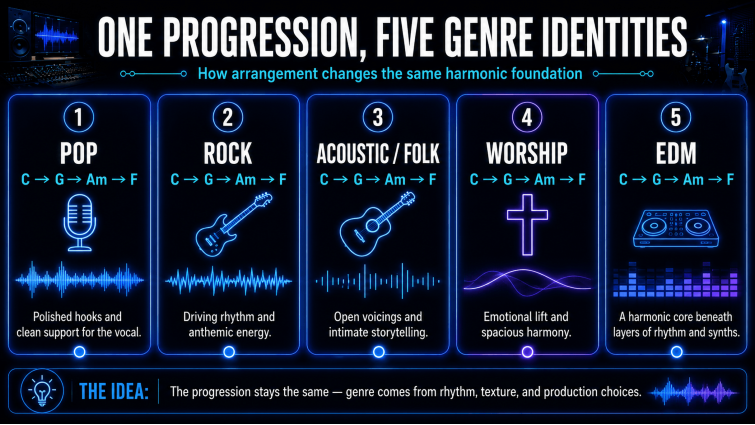
The Gen Alpha Melody video is a great piece of structural work by Dane musician Carl Martin, who wrote a great melody only to realize it was the underpinning of at least 72 other songs, including numerous hits. It’s an extraordinary bit of detective work.
Gen Alpha Playlist (incl. Madison Beer, Clairo, The Strokes, etal)
Context Matters
It piqued his interest because the music business is litigious and it seemed unusual that this common structure should be so heavily utilized without running afoul. To some degree Martin is certainly right, and in the micro, it’s a terrific analysis.
But the context is sort of what’s missing, and that’s why it’s important. For one thing, many of the songs he notes take superficially different routes to the dominant chords he notes, that can be important in court. Two, there are a lot more elements to music beyond the chord structure.
Martin is betraying his callowness when he peacocks his discovery's importance, given the “axis progression” has surely driven even more songs, so much so <dramatic pause> it’s not even novel anymore. (/foreshadowing)
Nonetheless it’s sort of fascinating and a very powerful reminder of how much popular art, like journalism, is a gated pack of ass-sniffing hounds. (See, the story that launched this essay.)
It’s almost fair to wonder how it could be any other way. There’s just so much wealth and power at stake driving the motivations of the people paying for the artistry. They’re selected not so much for talent necessarily, as their potential to land in a previously renumerative bucket. Our culture’s risk-averse like that now. If you don’t fit the bucket, you’re probably not going to find a lot of support. (In some creative fields support is overrated; some have supportive undergrounds.)
Of course, success is something that’s sort of back-engineered. The financiers and their lackeys typically base their decisions on prior successes (cuz they generally lack real taste-making qualifications, such as they exist) which dictates their ability to successfully market them. It's a strong streetlamp effect, which succeeds because it's so subjective. Who can tell if you're looking in the most efficient place for stars if you throw tens of millions into marketing?
The formula makes the decision easier for the marketing , talent evaluation and executive teams (see earlier, lack of quantifiable qualifications) and less prone to second guessing. Just hop one hot train – already out of the station – after the next. Call it Artist Development!
Art is Theft
Obviously there are those who appreciate any trend / trope / formula is prone to diminishing returns. The more you’re exposed to any message the less vital and impressive it becomes. It's the law of diminishing returns, though in marketing it's called signal or message fatigue.
There's even some suggestion that as a culture we're suffering from message fatigue – one measure of creativity (Torrance scores) have nosedived for a decade. The story suggests we're overscheduled and overstimulated with less "boredom" to be creative, but life is much more convenient than three decades ago, so perhaps the source is our temptation to automate, simulate and copy rather than step back, innovate and create something not in demand – a focus on the end rather than the process, and an over-reliance on shortcuts (clichés & tropes, stock characters/ideas & formulaic situations/constructs).
Chuck D once sang, "Your subject love is minimal, it's sex for profit," and the trade's not changed much in three decades. Without reinvention, all but the most durable products grow stale, proportional to their essentialism. It’s sort of why clothes are so prone to fashion: Why else would you need to buy more? (See also, Planned Obsolescence.)
One of the things that Martin keenly notes is that the diatonic ending of the first half of the musical phrase impels the resolution provided in the second. It's a release from a moment of unease, keenly suited to romantic songs, like a dramatic pause, only it's becoming Shatner-ian. (see also, stilted)
This answer/response structure is implicit to almost every form of storytelling. You are literally frustrating the audience to provide them a treat a moment later. It’s so operant conditioning, it could be a Skinner Box. Cultivated over years of media promulgation, but probably implicit to how our mind is wired for story. Perhaps that’s another side-effect of having a mind more interested in predicting the outcome than seeing it.
Like the Hero’s Journey or the Prodigal Returns or even the Comedia Dell’arte, which featured stock characters in familiar plots improvising dialogue, there’s an aspect of being human that revels in narrative (for better and worse) and music is no different.
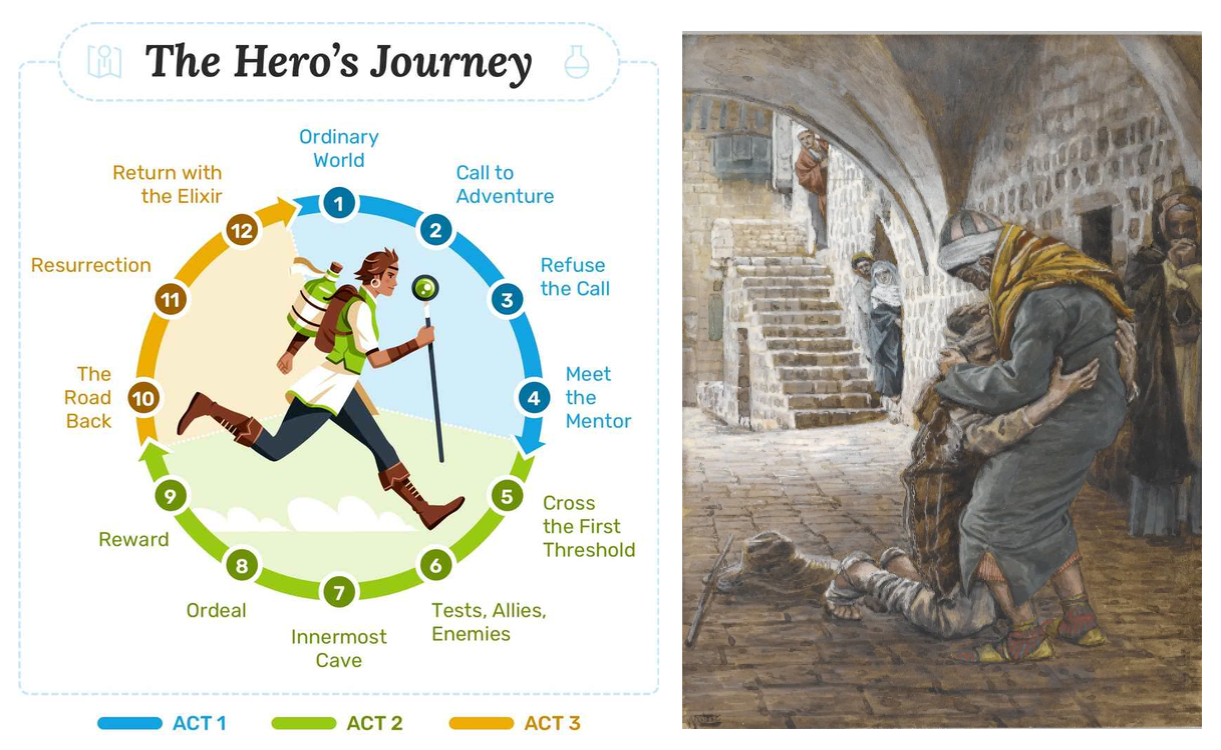
The story must have a complication, something wrong or there’d be no story. You mostly embark on a story with the collective knowledge it will be resolved in the end. Just by the nature of life, certain conflicts are naturally going to arise and be mined endlessly. (See also, Love, a recent, at least originally, literary development.)
(Either that or you become known as the type of creator/audience that doesn’t satisfy expectations and that’s generally bad unless you persist until it turns very very good, if at all. But hey, enjoy the process.)
Musical structure is just a shorter distance. I mean, I’m not going to get into it. I didn’t go to Berklee, but here’s the Cliff’s Notes on similar but different familiar musical structures and a video on how much variability there can be within such a structure.
Even Cliches Had First Kisses
Let’s get back to that idea of risk we mentioned earlier. As life changes the types of behaviors deemed courageous change. It’s just norms.
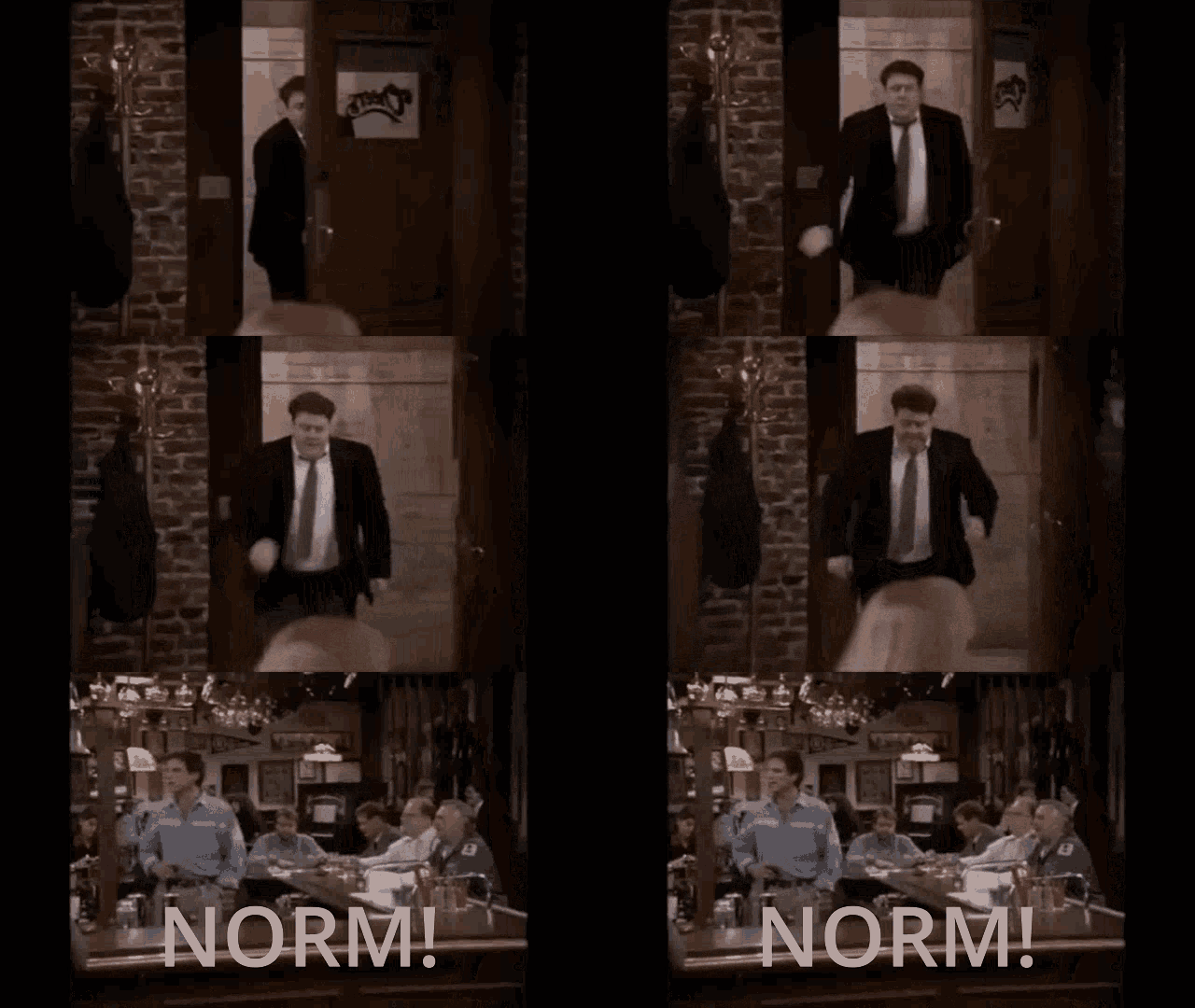
When something becomes accepted, paradoxically, its narrative power decreases. There are huge environmental aspects (also, cultural unconscious aspects) driving this, and if someone wants to get into how westerns begot cop shows, have at it (Apparently Elmore Leonard is emblematic.) I’m mostly concerned with how quickly we can change of channel.
It’s probably intuitive to most of us that what was once exciting and fresh will with time become cynical, hackneyed, shallow and overplayed. Our human adaptability is a blessing and a curse.
Creative media is definitely the medium where industrial fans blow bulldozers of crap onto giant corkboards. There’s enough money at stake there’s a scale to the storytelling stink. It’s where tropes and cliches are nurtured.
Of course they didn’t start that way, but we humans are bred for complacency when not fighting for survival. (I get it’s a contradiction, deal with it.) Nothing anyone wants to so much as to win once and be able to coast forever more, like our president. This is why legendary UCLA coach John Wooden opined that if getting to the top was about talent, staying there was about character.
It takes just as much effort to stay on top as it took to got there, but once you’ve put the effort into getting there, many have the first thought, “how do I pull up the ladder?” It takes a certain integrity to continue to give the same effort to your process – or more – after success as before.
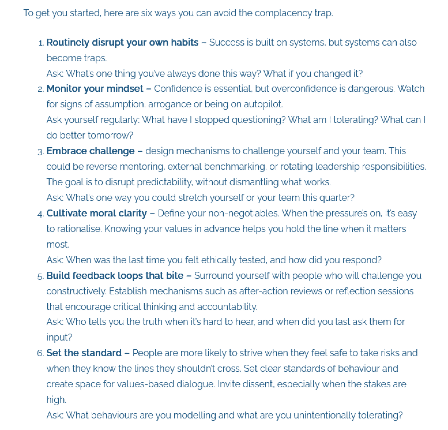
It’s about fighting off the natural urge for complacency – to enjoy the spoils of your victory. To forget for a moment that all victories are provisional, bound by circumstances and time. There are a lot of elements of continued success, and this is a good quick list, but the basic idea is to continue to challenge one’s thoughts and approach while being willing to take risks without fear of failure, providing one doesn’t wander too far beyond the scope of your expertise.
When I was in college my media studies teacher Jerome Stern conveyed a four-square box which he saw as the kind of cultural cycle of life. Stern saw most art starting with outsiders and other cultural relic hunters pillaging art that had gone out of style decades ago and repurposing or recombining it. (Here's his fine list of what NOT to do!) This is where cliche goes to be reborn.
From there, if it progressed, it would be picked up by cultural critics, the sort of leading edge as opposed to the bleeding edge. Like Japan with televisions. They didn’t create it, just mastered its production.
The rest is pretty straightforward and familiar. From the culture setters to the middle class and bourgeoisie then onto the lower class, and finally flushed from the system for the cultural Antique Roadshow decades down the road.

The operating principle underlying it is that the wider the base of interest the more featureless and indistinct it becomes. To appeal widely, you make the pool shallower. However, the more you water it down, the mores zing is lost. Something predictable and banal has a hard time sparking your brain. There’s no mystery, no surprise. It’s a trope, a cliché, a telegraphed outcome denying you any mental/emotional payoff, i.e. a waste of your time (unless you’re not discerning, which obviously operates on a spectrum – defined by idiosyncratic “jump the shark” aesthetics, aka "taste").
This is how continually mining the same success, the same formula, eventually turns into a huge loser, because what people want is something familiar that feels different, not different actors in the same laundry, with the same “complication – failure – enlist help – fail – montage/ work hard / Underpants gnomes’ “????” – win” payoff. If the elements don't get jumbled a bit, we lost interest eventually.
The notes within that are going to be different. The tempo or the casting might be different. But there’s nothing much new under the sun because the unfamiliar puts people off until it’s just familiar enough to be novel. Usually that involves making a twist.
Success & Failure: Twins Separated at Birth
The funny thing is that the most successful artists only worry about the process. They create for the intrinsic sense of creation, binding their expectations up in the process and not the result. This takes, in my experience, a certain level of success in order to be satisfied with the process alone.
To analogize, I was 40 before I was ever married, and I was somewhat wracked by that failure. I might’ve been alone at that point forevermore, but it wouldn’t have been my choice. Now after a 12-year marriage, I still miss the companionship, but I have no remaining illusions about marriage and long-term cohabitation, and if I don’t get married again I am much more confident it will be a choice I made rather than one that in any way was thrust upon me.
That’s how success and failure need to be, because they really are kin separated by what happened to them. Often there is nothing different in their upbringing. Both success and failure (ideally) endured the same upbringing.
The difference is that success incentivizes staying the course. Without change or complication, usually nothing’s learned. (A craftsman, it should be said, is always tinkering with the process, just as a story is an amalgam of familiar elements, and the art is about subtleties that are easily missed.) This attention to the finest details is a process incepted by failure more than success.
Failure is in truth testimony to the willingness to accept risk, and why success’ status quo is a hidden trap that kills innovation. “If it ain’t broke don’t fix it” is the predecessor to “it worked fine until it didn’t.” There’s also a subtextual implication that accepting things how they are precedes failing to develop the skills to effectively diagnose the problem and solve it.
(To be fair, constant failure will undermine the process as well, sapping consensus on the path forward and undermining necessary confidence to implement the chosen program. See, the Cleveland Browns.)
That diagnosis ability is key because the path from good to great to genius is one of small, often subjective gradations. It takes the long skinny fingers of the brain to turn those screws. As with music, the question isn’t the number of notes you have or how many combinations they can create, it’s how many through tone and socialization produce the desired response. Or as Redd Foxx used to joke, “I say shit and fuck because people do.”
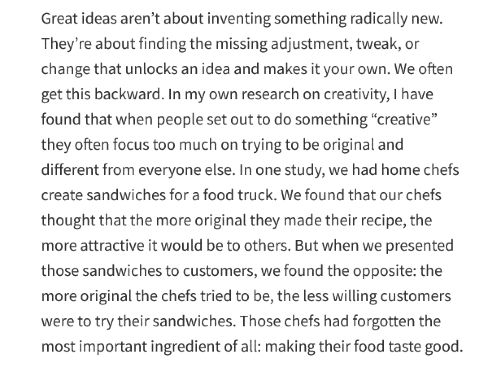
As George Newman suggests in How Great Ideas Happen: The Hidden Steps Behind Breakthrough Success, it’s about finding the part of the picture that’s off just a little.
Years have honed our responses to narrative and music because people made a lot of money producing the effect. The familiar works, but you need a twist. And how you achieve it may be by slowing down and taking your time. In an astoundingly odd experiment, psychologist Mihaly Csikszentmihalyi put U of Chicago art students in a room with a table of objects and a table of supplies and told them to do a still life using the objects on the table how they chose and take as much time as they wanted.
Art x Time = PERSPECTIVE
Csikszentmihalyi went back 18 years later (!!!) to survey which had become successful artists, and it was the ones who, instead of sitting right down and getting to work, had taken their time and interrogated the items and the space. As Newman puts it, “the artists who approached the drawing task without any preconceived notions and allowed the shape and structure of their still life to emerge from the situation itself.”
Indeed, many short story writers and musicians will store away work to enjoy a better perspective some period of time (weeks, months, even years) later. The pieces that don’t quite fit together stand out starker when the glow of having just created the piece fades. They’re still your kids but maybe they’re middle aged now and you can see the bad choices without feeling personally implicated.
Further, I would note that the single most important act in a work of art is its editing and it almost invariably involved trimming something away. Life is very complex and so there’s an excuse for creating complications, but it’s very much true the old literary saw that if something is not working toward the spine of the scene, it’s working against it.
Trimming away this excess is often the difference between great and merely good art. Stripping away what’s not needed, in personal experience, tightens focus which can intensify the emotional punch.
What’s the common thread? It takes a peculiar, particularized patience to properly cultivate a work of art. It extends well beyond the piece itself, with its interior mechanism and emotional payoffs. It’s also about the context of those payoffs, the agreed suggestive value of a series of abstract norms or series of notes have accumulated over time.
Yet those values are always in flux. What the culture values in the way of subject matter will vacillate, even as the structure remains the same. The goal is still surprising the audience and teasing their deepest desires before rewarding them for backing the protagonist. It’s all in the execution.
Clichés, tropes and formulas are the overly worn furniture of the story that distract us from getting lost in the characters’ emotional stakes. If we already know the outcome – and let’s be honest, we sort of already do, and we like that assurance – then what’s the fun of the ride?
As creators it’s our job to appreciate the culture temperature to avoid the sort of Hot/Not List of musical or narrative structure/content. Indeed, that’s very much the job of good editors, to pick over the piece and find the notes that don’t ring true. They’re truly the dowsers of the storytelling world, guiding us toward fresh springs and away from dry holes.
It’s really a fascinating dance that when you get good, and give over to the process, becomes less about creating a masterpiece and more about growing your skills and sensitivities in the service of telling a better story, which on the surface is an exceptionally superficial pursuit and equally is what you do every day in writing our life.